


|
|
|
9 August l98l, Sunday, from Manuel Antonio National Park, Puerto Quepos, Costa Rica
Hello to all
Yesterday began as one of those days when I question my sanity for being here. We took the bus from San Jose, the capital of Costa Rica, to Puerto Quepos, a town along the Pacific Ocean. It was a 5-hour trip...very windy and very bumpy...not entirely dissimiliar from many of our travels. But, for some reason, this time it really got to me, building up steam within, feeling a combination gurgle-scream welling up in my throat. Perhaps the 8 hours on buses the day before, traveling to and from the town of Limon on the Caribbean coast of Costa Rica, was enough for my body and soul without piling this bus trip on the very next day. Additionally, this trip to Quepos was very crowded. I sat between Robert and a woman with a squirming, slobbery, wet little girl. I could hardly move my legs...and pieces of this little girl's partially-chewed cooky kept falling onto my lap. It was stuffy, and the woman with the window that might offer us a refreshing (?) breeze didn't want the window open. She seemed to be concerned about how her hair looked...combing it repeatedly. I thought that was of questionable merit, considering the dust. I had washed my hair that morning, and it had become thick with dust in no time.
It was too bouncy to read. I slept some. (I amaze myself the places and positions I can sleep in.) The views were nice...But truthfully, we've seen so much of the same, and five more hours of it wasn't what I exactly wanted.
Often at such unrelenting moments on this trip, I find myself thinking of prisoners-of-war, shut into small cages for days and months. How do they maintain sanity? I say to myself, "if they can do it, certainly I can survive this." Then I begin my mind games. I make observations around me and try to keep mental notes... the vegetation, the birds, the terrain, the homes, the bus, the people, the pigs and turkeys and cattle, etc. I try to think of single-word descriptions for my impressions... things that differentiate each country. And I compose. I compose my letters in my mind. I compose my diary. Then I reflect on what I make of all this, plan my future and scrutinize the past.
Yes, there are a number of ways to keep myself occupied, but yesterday I seemed to have wearied of those mind games: I caught myself "daydreaming", a culturally-learned no-no. Twenty mental lashes, and I went to my "why am I here?" mind game. Then I reviewed all the things I've voiced so often: the adventures, experiencing the culture, seeing new countries, etc. To no avail. It didn't work to comfort me this time.
Finally I stood up at my seat just to straighten my legs for a while... but my head didn't fit then, and the bumpy road made it difficult to keep my balance, and I was getting some strange looks...especially from the driver. So I sat back down, feeling this "claustrophic scream" welling up in my throat. I finally slept some more.
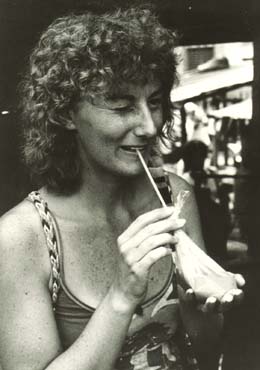
Once in Quepos, we found our way to a little family-run restaurant. The woman there brought me an ice-cold King Coconut with the top chopped off just far enough to allow a straw into the hollow center. Sipping on the chilled coconut milk was good and refreshing. We asked for directions to get to the beach at Manuel Antonio. The man there laughed and asked why we wanted to go there: "only trees", but they sent their son to escort us to the bus that eventually delivered us (only another l5 minutes, thank goodness) to this lovely haven...and immediately all those tortuous bus rides were worth it.
Here at Manuel Antonio we've hired a little cabana made of bamboo and reeds, just large enough for two little beds and our backpacks. It's shaded by the coconut palms that line the beach. We have about a 50-meter walk to the surf, which lulls us to sleep and conveniently drowns out the sounds of the five or six other people that we've seen around here. Sand seeps through the walls...and a few little crabs, too, to add to the atmosphere.
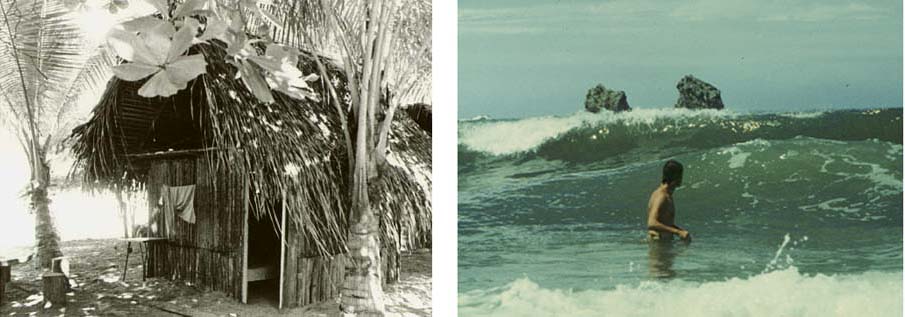
Wonderful breakers. Sandy Beach. Warm water. Our little thermometer shows it's 84 degrees in the shade of our cabana now and I think that's a bit conservative. Mmm...love that sun! We're getting nicely tanned...and thinner, too! Robert has to buy a new belt. He's run out of holes to pull it tighter and is skinnier yet. My pants could be taken in a couple of inches easily!
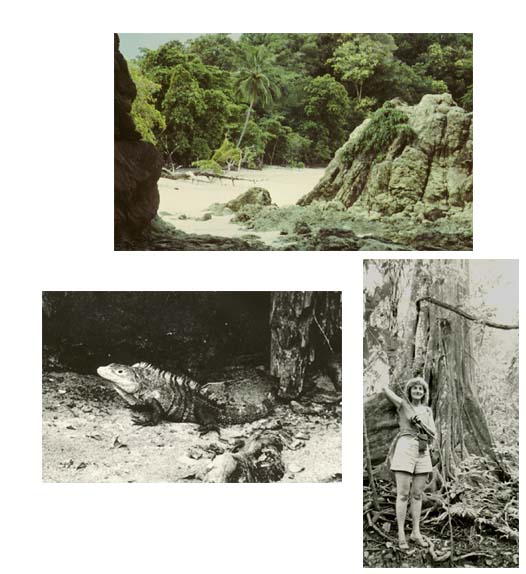
Today we explored the National Park area. Nice trails through the thick "jungle-like" trees. Palms, ferns, bromeliads, vines, huge philodendrons, orchids, and more beautiful flowers. The sounds of tropical birds and busy insects and always the waves crashing! And we saw several iguana! What fun!
We have discussed again the possibility of going to the Galapagos Islands, but it's really quite expensive, and also we're running out of the best time for hiking in the Peruvian Andes. We've decided to skip the Galapagos, but we got to see the iguana anyway.
Costa Rica has the highest standard of living in Central America. People are friendly. It's quite clean. And there are lots of fair-haired, fair-skinned people, which makes us a little less obvious. It's easier to find someone who speaks English here than it was in most of Mexico. So we feel pretty comfortable. It's nice to not be so extremely obvious when we walk down the street. It really does tend to get tiring to hear "gringo" and "go home Yankee" and to have children tugging at our sleeves asking for money.
And we like C.R. all the more because it came after Nicaragua. What a welcome change! Nicaragua really surprised us both. We're too ignorant of world politics. We would never have imagined the number of young crusaders who are drawn to Nicaragua wanting to help out in the founding of this Marxist state. Perhaps we should have been more clued in when we met people further north who asked us if we were heading for the July 19th celebration of the 2nd anniversary of the Sandinista regime.
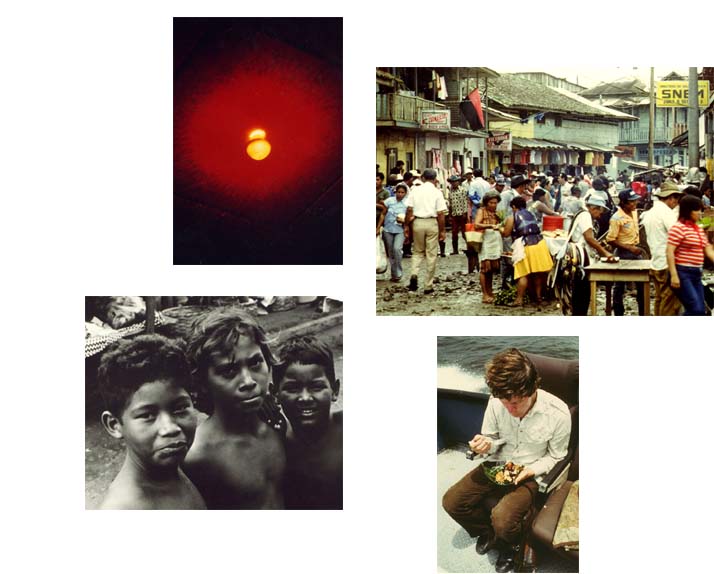
In Managua we saw more young travelers than in any other single area on this trip. And they so often claimed to like Managua. (Do you remember our opinion...last letter?!?) I met two young women who'd been there for three months. One, a Dane, had found some work to do; the other, a Brit, was just "enjoying it". We mostly met West Germans, who seem to have a great interest in the building of the new Nicaragua. All came here on their own. Very excited about the Sandinistas. Abuzz with news about El Salvador and Guatemala. It seems that Nicaragua must be a bigger news item in W.Germany than it is in Seattle. I regret that we're not better informed. We've finally found a good source of news for this trip: the Miami Herald International seems to have many pages covering situations political, social, etc on Central and South America. Reading that, much is explained that has puzzled us. For instance:
We had planned to go from Nicaragua to Costa Rica by an "adventurous" route we'd learned about in our researches. We began from Granada, on the northwest shore of Lake Nicaragua. When we went to the dock to board the boat, we were escorted to an office for passport check. There we were faced by uniformed and armed soldiers, who, when they saw my U.S. passport, asked me if I was CIA. I answered in the negative, and one of the soldiers pointed a rifle quite uncomfortably near my face and repeated "CIA?". I don't even speak Spanish! Well, they eventually let us continue.
Lake Nicaragua is big and it was a 6-hour boat ride to San Carlos at the southeast end. San Carlos was thick with soldiers. They, of course, stopped us to ask what we were doing there. When we explained that we planned to hire a dugout canoe to carry us upriver directly south to Los Chiles, Costa Rica, (from where we supposedly could take a small plane to San Jose for only $ll), we were told it was no longer possible to cross the border from the eastern areas of Nicaragua. There were several other travelers, too, who were planning to head even further east before they crossed to the south, and they, too, were told it would not be possible.
At that moment, however, the most important thing was a hotel and food. San Carlos was the PITS!...mud and insects so thick you daren't open your mouth to talk (no exaggeration)! And we wallowed through this in search of a place to spend the night. Assumingly it was because of all the soldiers in town, but all the hotels in this god-forsaken place were filled! As we were beginning to feel desperate, one hotel finally made a bed for us in an extra room and the two men who'd been searching with us were bedded down on the floor outside our door. We passed the evening with a very interesting and informative German man, sipping beers and shuddering at all the insects. Trying to keep insects out of beer and mouth, we kept our beer glasses covered with napkins and parted them just slightly to drink. Very few lightbulbs were illuminated, for obvious reasons, and most of those that were were bare red bulbs, to again avoid attracting as many insects as possible. To find our way to a toilet and wash basin, we had to go past one of the lit bulbs and "swim" through a swarm of little insects and feel masses of them hit against our faces. Yuk!
Well, we survived the night. The town didn't look much better in the daylight, but at least the insects were less bothersome. Now we searched out the military command to again ask for an exit permit from the country at this point. Someone had advised us, "No problem. Just convince them that you're friends of the Sandinistas and they'll let you pass." Hehheh. Thanks, anyway. How does one go about proving that? Well, we were given another "no" and it didn't take much persuasion for us to decide to get on the boat leaving shortly for the trip back to Granada and travel out of Nicaragua via the main highway.
So what does this have to do with the Miami Herald International? Since we've
left Nicaragua, we read a lengthy article about the military build-up
in two areas of Nicaragua. San Carlos is an entry point into
one of those regions. They're training and equipping an army
now twice the size that Somoza's forces were during the revolution
'78'79...preparing to "help" El Salvador and Guatemala
in their fights for "freedom". Yes, I can understand
why they discourage travelers wandering around and why they would
question if I was CIA. Now I wonder why I wasn't detained more,
actually. Well, I'm glad to be out of Nicaragua.
Travel Letter #5 continued l5 August l98l from Panama City
I've already discussed a lot about buses in this letter, but I feel compelled to share our latest trip with you, too... from Manuel Antonio to Panama City. I'll try to keep it brief. (!?!) We left M.A. at 6:30 AM. Seven buses and 34 hours later, we arrived in P.C. The first bus was brief and easy. But the second was an incredible 2 hours to travel 40 km... slow and bumpy. That ride came to an abrupt end at a river. Everyone got off, and we followed, crossing a bridge that was upstream a ways. There we waited for our third bus of the day. That was another 40 km trip, but this time it took 3!!! hours! That becomes the fourth addition to our compilation of data for a book we could entitle "Bumpiest Rides of the World", and it moves to the honorary position of the bumpiest of all. About half way along, something broke loose, and a terrible knocking sound started by the rear wheel that was only 2 seats ahead of us. I could see the floor convulse and bend and bang with every bump. So I sat there wondering what would happen if the rear end fell off ... and contemplated if there might not be a better place to be sitting. But the bus held together ... until we got off of it anyway. They really build 'em tough. The next bus was true comfort on the Pan American Highway and covered about l44 km in 3 hours. The next day and 3 more buses brought us to Panama City.
Panama City ... where we can watch the sun rise over
the Pacific and set over the Atlantic ... the only place of such
distinction in the Western Hemisphere.
Another distinction of this country is that it's the only country
that doesn't print its own currency It uses the U.S. $
and calls it a "balboa". It seems so strange to see
the dollar bill being used in such out-of-the-way
places by colorfully-dressed Indians and these "bus
drivers".
Another distinction, but for us this time. We took a plane flight yesterday. We visited the San Blas Islands east of the Canal in the Caribbean. We could hardly believe what we saw over the pilots shoulder as we flew in (it wasn't your regular 747). The islands are very small. The landing strip filled an entire island, and that was one of the larger islands. There were a few buildings on that island, too, where the island was a little wider than what the airstrip needed. Beautiful islands. Too beautiful to be real it seemed. All very flat with quite shallow waters, showing the white sands through the crystal blue waters. Quite a long ways out from the islands toward open sea we could see where the waves hit a long coral reef that protects these 365 little islands. The water is warm and calm. We swam about 2 hours ... but thought it wisest to get out of the strong sun then.
The Kuna Indians live on these islands. In the traditional ways of centuries, they live in palm-covered huts and wear colorful, handmade clothing. The "mola", which is made by the Kuna woman, is known to many people throughout the world as a unique and beautiful native handicraft. A mola is a picture, usually of an animal such as the parrot, all in many colors of fabric and threads, worked in a reverse applique. Two large molas make up the body, front and back, of the Kuna woman's blouse. A long piece of colorful fabric is wrapped from the waist for the skirt. Decoration begins with a small gold ring in the nose and one or more heavy gold necklaces. What I found perhaps most beautiful and fascinating was the bead work on lower arms and legs. Small yellow and red beads are strung and wound tightly from the ankle toward the knee as well as from the wrist toward the elbow for perhaps l0 to l2 inches. They are strung with such intricate care as to form a lovely pattern or picture. We never saw young and still growing women with any of this beadwork done to any extensive degree; and I'd feel certain that it's probably changed very seldom, if ever, during a woman's lifetime.
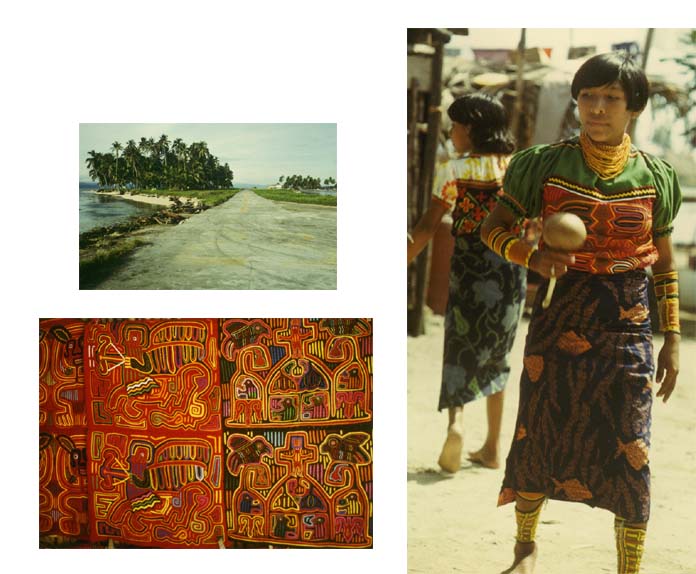
Well, the San Blas Islands are not a place one just happens by or can observe casually unfortunately. We were there on a oneday "tour". On the flight back to Panama City, we had a fantastic view of the Atlantic and the Pacific with the narrow Panama's Darien Gap peninsula between. Exciting and one more distinction of this unique country to see both oceans in one glance.
And, of course, we have visited the Canal. And it is really quite fascinating. Today we saw the Miraflores Locks in action. Tomorrow we shall take a train ride that follows along the Canal (and sometimes over the water, too) to the other end of the Canal and visit the Gatun Locks.
On Monday, we fly to South America! We are now at approximately the 9th parallel. Robert informs me that when we're in Quito, Ecuador, which is very near the equator, the sun will set at 6:l4 PM, as it does every day of the year. Evenings are always dark and come very early.
In Panama City, we've met two people who've lived in Ecuador and they love it. Everyone seems to like Ecuador. We've got a growing list of places to see, and it will be hard to make a dent in that in our 2-3 scheduled weeks. But on we go!
Adios! Schüss! Kram! Ciao!
|
|
|
[Letter 5] |