


|
|
|
Travel Letter #4 |
Hola, everyone!
We're living like fat cats tonight! A really nice room ... nice
enough to live in, and we had a big Chinese dinner. You know how
Chinese food is always too much to eat. But I needn't
ask for a "doggy bag" ... I just pass my extra across
the table to my everlovin'! (What an appetite he has!) This
is really outrageous for the standards we've set ourselves, and
I must explain. We arrived in Nicaragua today. There's a black
market for dollars here in Nicaragua. That we'd heard and anticipated.
But we hadn't anticipated that the money changers would be waiting
for us at the border. There they were ... in front of the military
and everybody. I always had thought "black market" meant
sneaky dealings, but obviously not so here. The official exchange
rate is l0 cordobas per US$. We
got 25. Think about what that does to our expenses. It's fantastic!
So this fantastic room with private bath, clean sheets, electric
fan, and which truly I could feel proud to house my parents in
is only costing us about $7.00.
I want to explain about the Chinese food, too, in case you should wonder why we eat Chinese in Nicaragua. (The Chinese are everywhere, aren't they?) Since we left Mexico, the food has really been boring. It's disappointing to both of us because we like to try local foods ... usually expecting a difference in spicings and the use of special foods available locally. But all we get now is rice, beans, and a tough piece of meat, sometimes with a greasy, hardfried egg on top ... very plain and very boring. There should be fruits and vegetables you'd think. We love fruits and vegetables. We do see them for sale in the streets pineapples, coconuts, watermelons, and other local fruits (plus Washington State red delicious apples) all sliced and ready to eat (after chasing the flies off), sliced with a mighty machete that undoubtedly has never been washed. Sound appetizing? Thusfar we've bought only when we can take it whole and cut it up ourselves. We've bought big pineapples for $0.20, picked guavas off the tree, and tried something called "hog plum" once, too. That smelled incredibly inviting, but there was disappointingly little fruit around the pit and it hadn't much taste. Let's see, what else? Lots of bananas, which seem to come in a wide variety: some to be fried, others to be boiled, and even some which can be eaten raw! Some mangoes, but sadly for me, Robert doesn't care for them so much. And yes, breadfruit ... a big nothing. We've been served that several times boiled, like a big potato. We've been told it's better fried, but haven't yet had the honor to try it thus. We do buy fruit from street stands quite often in one particular form: squeezed into the delicious and refreshingly cold fresh fruit drink called "licuado", made from such as pineapple, tamarind, blackberry, etc. Wonderful. But for meals it's mostly rice and beans, rice and beans. At one place where they advertised "creole food", I asked to be served a "typical creole" meal ... and got rice and beans, rice and beans. When I asked where the creole food was, I was told that it was there rice and beans! There is also, of course, the alwayspresent tortilla very bland. We're hoping South American food will be more exciting.
Our last letter was from Guatemala City two whole
countries ago! We went from there directly to Honduras. The Mayan
ruins of Copan lie just over the border. In fact, all the way
from the border to the excavated ruins, more "mounds"
were pointed out that have been discovered to be more ancient
ruins, so there's a lot more excavating to be done. The mounds
are completely grown over now and look pretty much like ordinary
hills, except when one carefully notices exactly how they lie.
One very high mound has a house atop it, and it's believed that
a temple is under all that. (Imagine having your home (pretty
much of a "grass hut") on top of a temple!
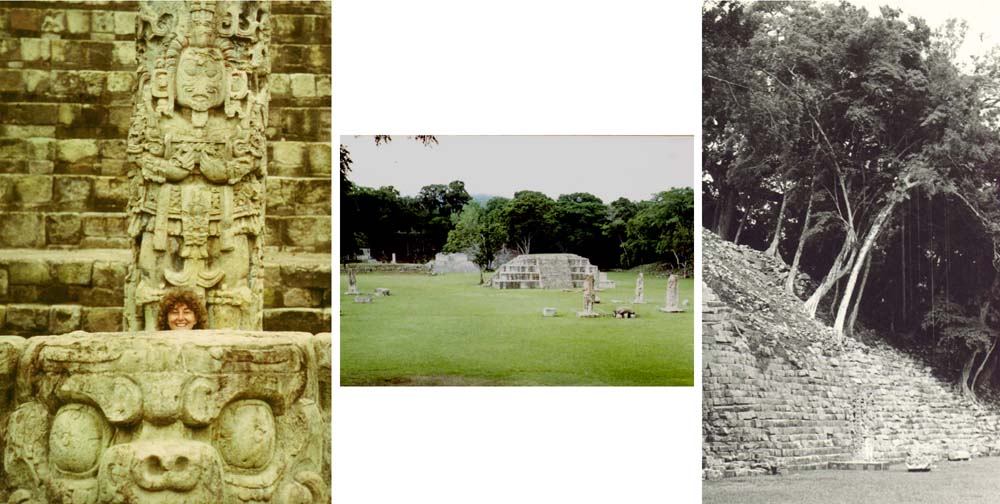
The ruins of Copan were great! We went early in the morning before
the crowds. When we arrived, there were only about four others
wandering around. When we left a few hours later, there must have
been a couple of hundred people there. It was a very special day
actually. The President of Honduras was there to cut the ribbon
for the opening of the new highway tying Copan with the rest
of the country. They're lovely ruins and the country has every
reason to be proud of them. The many carvings and statuary were
exceptionally wonderful. We have rarely seen ruins with so much
of the statuary still remaining at the site. They are most often
removed for protection at a nearby indoor location or to the capital
city on display in a museum. This was a fantastic way to view
them. We climbed up the temple stairs and sat quite a long time
looking down on the ball court and the rows of buildings; and
we reflected on the people who created all that, the work involved
in the construction, and on the people who once lived here and
walked through these courtyards. We're not at all tired of seeing
ruins yet, but don't think there are any more for us now until
we get to Peru.
Is it only two weeks since we were making mad dashes to avoid rain drops? (more like "buckets" as I recall actually) And now my "Golden Boy" is peeling, and I ... I am practically "molting"! Since I last wrote, we have spent one heavenly week on the little Caribbean island of Utila. It is one of the Honduras Bay Islands, about 30 km from the mainland. We'd heard some about the islands before we travelled there, but we weren't at all prepared for the shock we felt when we stepped ashore. We walked around with eyes wide and mouths agape for several hours. First of all, the waters were the clear blue that was depicted in all the entirely outofplace cigarette commercials of my childhood ... and warm like in a dream! (water about 8085o F. and air temp in the 90's) Secondly, the people are all blacks and whites. Essentially no Spanish or Indian people. And the language of the island is English! This was an English colony until l857. But consider how long that is for such a small group to be separated from their mother tongue ... the accent that's evolved is like no English I've ever encountered. It's crazy to listen to!
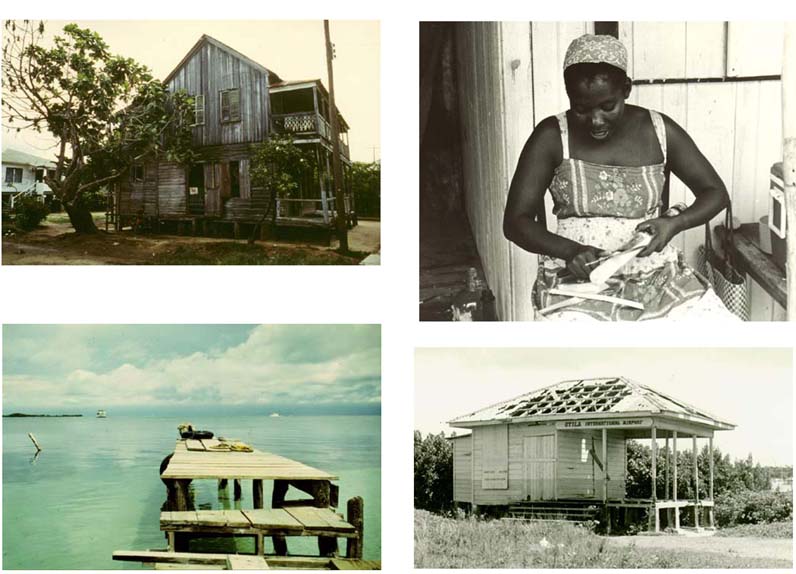
Thirdly, the people are so relaxed and easygoing ... there
could never be any distrust. All our weeks travelling thus far have
been with a constant tension and awareness of potential thieves.
But in Utila, we were there 3 days before we could corner anyone
to take some payment ... and we didn't register our names until
the day before we left. We never saw a key for our room ... in
fact, most people didn't bother closing their doors. It's better
to let the breeze in anyway.
So we were really lazy for that week. I thought several times
of writing a letter, but it seemed too energetic, too out of keeping
for our "vacation from travels". We did go snorkeling
and Robert went diving one time. It was beautiful. So many different
corals ... some that look like "brains", some like long
tubes branching out, some like big rocks, puffball mushrooms,
etc ... and the big lacey, lavendercolored fan coral that
I always remember sitting on Mom & Dad's piano. (Whatever
happened to that?) A lot of different fish ... even small squid,
some moray eels. Other interesting wildlife of the area that we
saw: dolphins, pelicans, a big sea turtle that eyed us briefly
and then dove out of sight. And all over the island were a funny
little "land crab", 24" across and a shiny
blue color. They were constantly busy digging their holes. As
we walked along, we could look ahead and see the illusion of the
ground quickly moving as the crabs dashed for their individual
little holes. Some of the bigger ones played brave and would wait
at the edge of their hole as we approached and darted away at
the last minute before we passed. Funny things. We were told they're
quite edible, too; but we never had the "honors".
Our first day there, we snorkeled about 3 hours. I wore a tshirt
to protect my back from the sun, but I didn't think of long pants.
The next two days were quite excruciating when I tried to move
around, and I didn't venture much out of the shade. But the salt
water felt great, and we didn't miss a day for swimming. I just
stayed face up. So now it's only the back of my legs that are
peeling. I was more careful the rest of the week. We'll both be
ready for more sun soon.
now 3l July l98l, Friday Managua, Nicaragua
I know there's more I want to say about Utila, but it escapes
me just now. Perhaps it'll come back if I think about something
else. Although we stayed a whole week, the mood of the place is
so lazy (and we caught right on to that without any difficulty)
that we didn't do all there was to do. As we left, we travelled
all the way to Tegucigalpa with an interesting, young islander.
He told us about more of the island ... but one can't walk there,
you must go by dory. Great diving, beautiful, lots of unique bird
life, seclusion. Hmmm, we just might return to Utila some day.
Tegucigalpa, capital of Honduras, is a nice city. Not too big,
it's peaceful and pretty clean, lying in a valley and spread up
the surrounding hillsides.
To travel from there to Managua, Nicaragua, we'd heard about a
particular bus line that seems to go through all of Central America
and seems to be for tourists, Tica. We checked on that, and their
$l5 price seemed too high. Also the
departure time wasn't real convenient for us. My passport was
at the Nicaraguan consulate overnight for my visa application
and we couldn't pick it up until after 8 AM the bus
was leaving at 8:30 from across town. By the way, I've had to
get visas for each C.A. country so far Guatemala,
Honduras, Nicaragua, Costa Rica but Robert hasn't
been required to obtain any. Sometimes being an American isn't
so convenient. But it's fun to have the nice big visa stamps anyway.
My passport just might become filled on this trip
only 6 pages left.
Well, we found our way from Teguci to Managua. It ended up costing
us about $4.50 each and was much more
interesting. We took two local buses on each side of the border
... and could have gone all the way to Managua in the one day,
but we wanted to take the train from Leon for the last stretch.
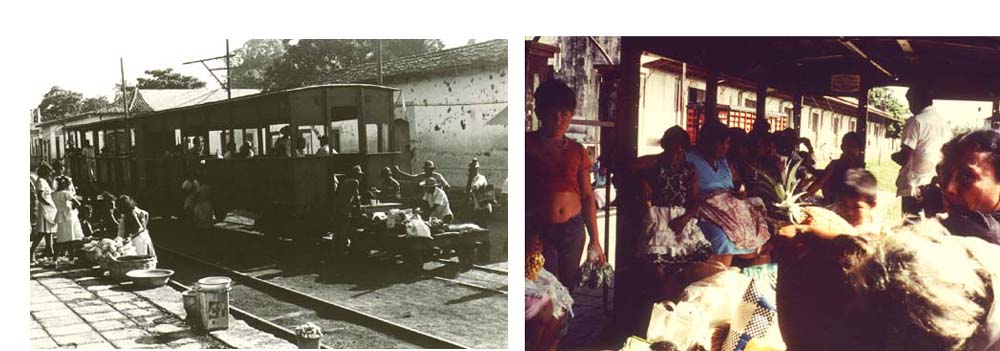
And that was fun! There were just two passenger cars, filled
with women with their huge baskets (well over a meter across,
flat bottomed so as to be balanced on the head, about l5 cm deep
... filled with all sorts of things: bananas piled high, clothing,
pineapples, chickens, etc), children excitedly gathering around
us wanting their pictures taken, and men doing very little, as
usual. The cars had a bench down each side and the "luggage"
filled the center. The upper half of the walls were open ... nice
and breezy. They reminded me of something from Disneyland or NW
Trek.
Some people we've talked to here came via the Tica
bus. It seems to have been quite a bit slower than our way. They
were, however, detained 4!!! hours at the border and had a very
thorough customs check. Actually, we'd heard that that particular
bus seems to have such customs hassles regularly, but that really
does seem incredibly bad. We were less than an hour. Customs was
a friendly surface check. Our only holdup was that passport
control couldn't understand my name change. They finally decided
to enter me in their books with the surname "Elvera Mconky
of Sandebg" (their spelling). I hope they won't have to match
up anything when I go to leave the country. Maybe I should be
glad they're not computerized.
Can it be only 7 weeks since we left home? So much happens to
us ... our world makes so many changes and we absorb so many impressions
and experiences. Sometimes we think back to a prior village, country,
experience and think, "That's only a week ago!?!" I
devour all the news magazines and papers I can find. But the rest
of the world seems to be moving at a much slower pace than we.
I expect much greater changes, but things don't change so much
really ... except for us. I guess it's us that are out of whack,
eh? I must say that your letters are devoured and analyzed with
the same intensity. It may have been only 3 weeks since we last
picked up mail, but at the pace our world is going, it seems like
3 months. Your letters are so welcomed and appreciated! Thank
you!
Now ...Now I want to try to describe this city to you. Managua.
Managua, capital city of Nicaragua. It's like nothing either of
us have ever experienced before. I'm not sure I can express it
aptly, but here goes an effort:
The train station was no larger than one of a small village in
Mexico. But even at the smallest village in Mexico, the place
would be alive with people. Here, there were no women and/or children
hawking their wares. No buses waited, no taxis, no children jumping
at us to take us to a hotel. We stepped alone through the door
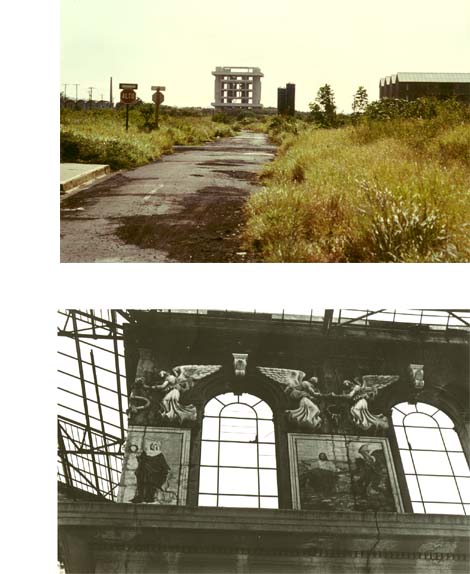
of the station and looked around at a vast nothingness. There
were lots of streets winding around, forming familiarcity blocks.
But all the ground between these avenues was weeds; fields of
waisthigh weeds. Occasional blocks housed the shell of a
building, often 6 to 8 stories high. On closer examination of
a field, one could see the remainders of a building's foundation.
We could see for a long ways. Vast open spaces and these skeletons
of buildings that we could look right through. About a mile to
our right was a cathedral. All the walls still stand, but there
is no roof. Straight ahead a mile or better appear masses of onestory
buildings. And in the further distance, just as a hill begins,
there is one very modern structure that appears undamaged and
quite alive. That turned out to be the busy Intercontinental Hotel.
We asked a passerby the direction to the center. He looked at
us strangely and just shook his head. So we asked for hotels.
No, no bus goes to the hotels, and he pointed toward the Intercon.
It's a long walk with these heavy packs and a hot sun. We trudge
on ... between skeletons of once modern buildings. On one we can
make out the outline of a past name: "First City Bank".
Inside was a shambles, and the ceilings looked charred. Suddenly
we found ourselves in a nice plaza, very clean, nicely landscaped,
ultramodern in design with several small buildings with
redtiled roofs and cedar paneling in a fashionable diagonal
pattern on the walls. One was marked "turisto inform'acion".
Wow! Jackpot!
There we asked for a map and hotel information. We learned that
Managua is very spread out, with no actual "center".
There's a building here and a building there. Very little seems
to be marked. No signs telling what a building houses, and no
directional signs to help us get around. We have walked and walked
but haven't found any area filled with all the little shops that
we normally find selling shoes, hardware, paper, snacks, soft
drinks, sewing services, shoe repair. No people on the streets
with their vending stands.
We walk and walk, along the paved streets, around the fields of
weeds. We see a statue with a bench nearby. Then more fields of
weeds. The remainders of a building with an old faded "Coca
Cola" painted on the side. Sometimes a family will have made
use of a few walls and section of ceiling to make it their home.
Occasional buildings with all their walls and full ceiling will
house a theater maybe or the post office, but it may be a half
mile to the next occupied building.
Earthquake l972. The world sent aid. Managua could have been rebuilt,
but the money went to Swiss bank accounts, and one man and his
family became wealthy. Revolution l979. And now they must begin
again with what they have left. Earthquake and revolution. It's
impossible to distinguish which reaped what damage. Utter devastation.
Unsettling. Depressing.
Some whole districts around Managua have been developed now, spread
apart from one another like "American shopping centers".
We cannot sort out the bus system or find that any of the lines
go in the areas we are in or want to go to. So to go to an agency
we need, we begin walking. Up a hill and around a large fenced
area. Busy 4lane street but no buildings ... It felt like
walking in the country with city traffic forcing us to walk in
the ditches. On the top of the hill we found that it was actually
a crater; and looking into the crater, we saw a beautiful lake
with a few people swimming, amphitheater seating alongside the
water at the far side. We walked on, through a highway cloverleaf,
heading toward a distant group of buildings. It took us more than
an hour in all, but we finally reached the area. No side streets
were labeled, but we tried one anyway ... It was like walking
into surburban San Jose, California! Treelined, nice onestory
houses. And, incredibly, we found what we were looking for ...
an airline company. They couldn't help us at all, and in utter
weariness, we broke one of our unspoken pledges: we took a taxi
the 3 miles back to our room.
One more day in Managua. Tomorrow is a big celebration with procession
for about 6 miles. We should get some good pictures! Then we'll
leave this nevernever land. !!
Robert's latest calculations: We have arrived at Managua via l
truck, l0 trains, 40 buses, and 3 boats (not counting intown
transportation).
Love to all!
|
|
|
[Letter 4] |