SPECIAL REPORT on RELIGIONS and LANGUAGES in INDIA
July 2000
Namaste from Robert
Indians often ask us how many kids we have. When we say none, they surmise that we are newly wed. Hearing that we wed more than 21 years ago and that it is our choice not to have children, they look incredulous. Some tell us that there are doctors that can "fix" our problem. But then what is the reason for life, others ask? So the conversation shifts to religion. India is incredibly rich not only in culture, race, language, food, etc., etc., but also in religions.
India’s religions with approximate percentage of followers:
Hinduism (84%)
Islam (11%)
Buddhism (6%)
Jainism (4%)
Sikhism (1.8%)
Christianity (2.3%)
Parsis (.01%)
HINDUISM
Over 80% of Indians are Hindus. Though the religion has undergone many changes, it can be traced back more than 4,000 years.
Worship: The great majority of Indian homes have a shrine for worship. Here and at temples many candles burn. People prostrate in front of deities and walk around the shrine. Coins are often thrown.
Puja or cleansing is performed early every morning by devout Hindus. This involves chanting the 1000 names for Shiva. It starts in a very subdued voice and slowly gets louder to culminate with loud bells. We love slowly being awakened from sleep listening to the beautiful chanting.
Ashrams are places of worship where gurus or leaders have built temples, where their followers live. There are many different ashrams in India and the gurus often have their own style of worship. We visited Amma’s ashram in Kerala. Unfortunately Amma was not there, so most of the activity focused on pujas, meditation, and volunteer work. When Amma is there, she performs darshan in the afternoon. She then blesses and hugs each individual. This ashram receives lots of donations and uses the money to build schools, hospitals, etc.
Rebirth: Hinduism believes that the soul does not die with the body, but instead enters a second body. The goal is to achieve liberation from this endless cycle of rebirth. This liberation is called nirvana.
Karma is the effect of former actions. By living a good life, you can aspire to a higher position in life when you are reborn.
Dharma is performing the duties laid out according to your position in life.
Gods: The Trinity consists of Brahma (The Creator), Vishnu (The Preserver), and Shiva (The Destroyer).
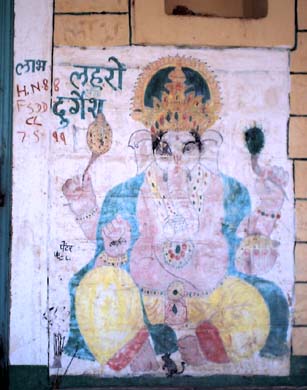
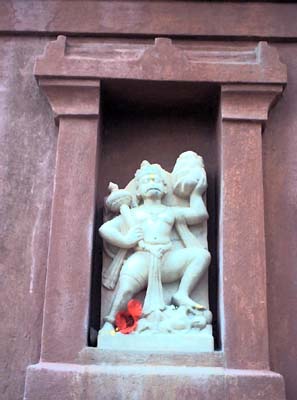
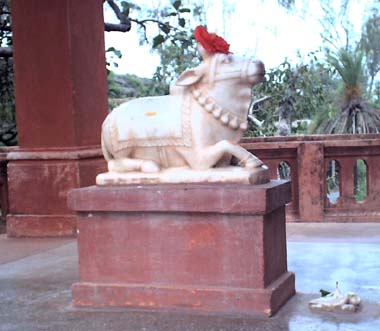
Incarnations: There are many, many incarnations. A few of the most important are:Nandi the bull is also worshipped, especially in Southern India.
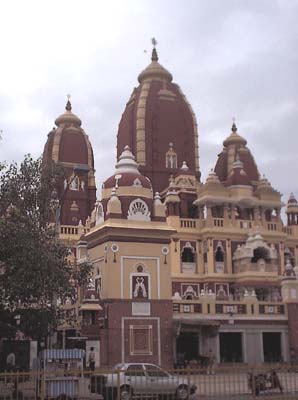
You can see these Gods and Goddesses as well as many, many more depicted on Hindu temples all over India.
So many Gods: Some Indians tell us that only the Trinity are the real Gods and the rest is myth and fiction.
Yoga is a way of self-denial and meditation to bring together the spirit, soul, and flesh. It can ultimately lead to nirvana (release from the cycle of rebirth).
Hinduism is a complex religion and this short description has only scratched the surface.
ISLAM
Islam is the second largest religion in India with over 100,000 Muslim believers. Islam became a permanent religion in 1206 by the creation of the Delhi Sultanate by Turkish powers. The victory of Turkish rulers created a 500-year period of Muslim power in India. Both Indian Islam and Hinduism were profoundly affected by the contact.
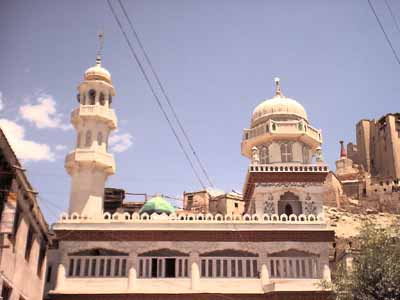
Five times a day prayers are announced from mosques. Muslims will prostrate facing the direction of Mecca to pray. The first one is announced loudly five in the morning, and more than once did we wake up then realizing that our hotel was close to a mosque. You will also often hear Muslims say "There is no God but Allah and Mohammed is his Prophet". The Qor’an is the holy script, the supreme authority of Islamic teaching and belief.
Islam traces its roots to 622 AD, when Mohammed migrated from Mecca to Medina. Both the Saudi-Arabian majority sect Sunni and Iran’s sect Shi’a are represented in India.
BUDDHISM
Buddhism came from early Hinduism. The Brahmin Siddharta Gautama, who came to be known as Buddha, founded a religion of meditation and religious philosophy around 550 BC.
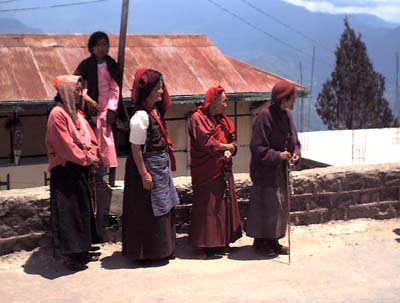
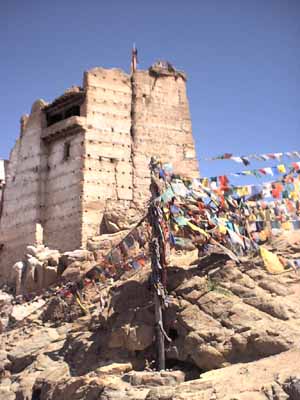
Buddhism was originally a major religion in India, but most Buddhists were killed around 1300 AD by Muslim invaders. Today there are about 6 million Buddhists in India, mostly in Ladakh and near Nepal and Bhutan. Most Southeast Asian countries today are Buddhist.
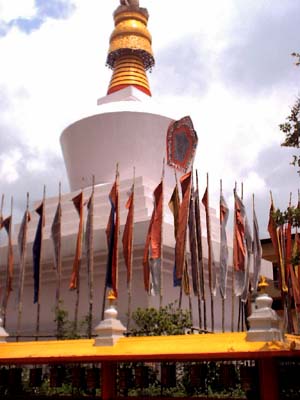
A clear sign of Buddhism is the presence of prayer flags, which are stretched from building to building, tree to tree, etc.
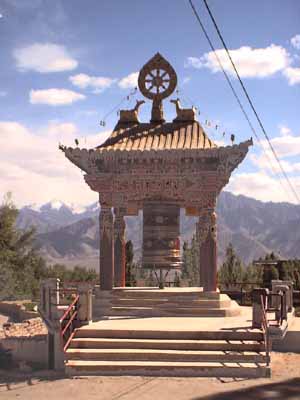
Prayer wheels are found around temples and in city streets. People spin them as they walk around them clockwise.
Like Hinduism, Buddhism believes in reincarnation. But a Buddhist must attain Enlightenment by studying to ever higher levels of learning to reach Nirvana (being freed from the cycle of rebirth).
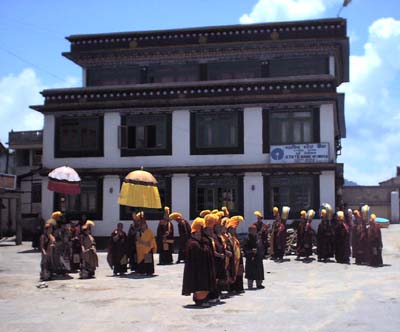
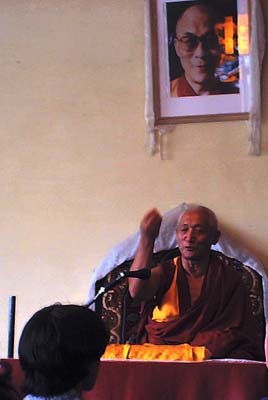
While we visited Dharamshala, we were extremely fortunate to meet His Holiness, the Dalai Lama (see travel letter #9). We also took part in two classes each day in Buddhist philosophies. Here are some examples of the teachings:
Hinayana is the version of Buddhism practiced in Sri Lanka and most other Southeast Asian countries; this refers to the Lesser Vehicle, where people strive for happiness for themselves only, whereas in Mahayana Buddhism, nirvana can only be achieved by helping others to become enlightened.
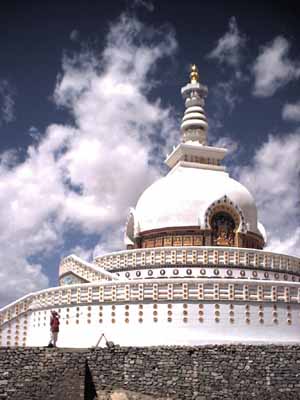
Peace Pagodas: The Japanese Nipponzan Mayohoj builds Buddhist shrines or stupas dedicated to world peace. There are about 30 of these peace stupas around the world outside Japan - most of them in India and Sri Lanka.
JAINISM
Jainism was created as reform movement against Hinduism around 570 BC (by the ascetic Mahavira). It has never spread beyond India and there are today about 4 million Jains.
Jains believe in the distinction between living (jiva) and non-living (ajiva). All the living are sacred – even the smallest insect – and cannot be hurt. Thus you sometimes see Jains sweep the ground before them to avoid stepping on animals by mistake. They also wrap a handkerchief across their mouth to avoid swallowing insects. They are ascetics, vegetarians, and work in commerce and banks, since almost all other businesses are considered violent.
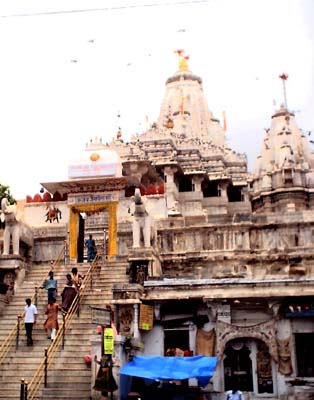
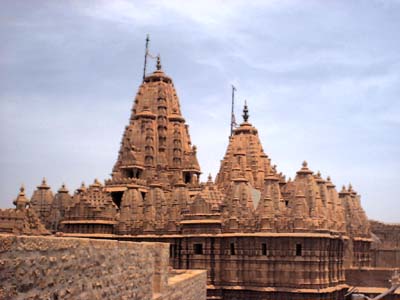
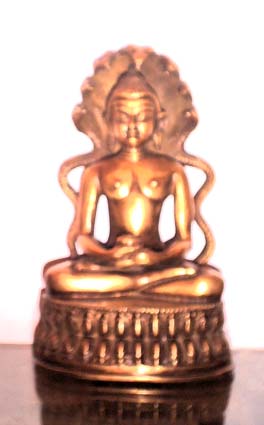
Jain temples are typically simple on the outside, but very ornate on the inside. Mahavira is displayed in many prominent locations. There may also be Hindu Gods and Goddesses, but in much less prominent locations.
SIKHISM
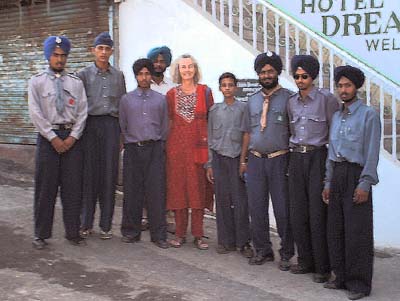
Sikhism was founded around 1500 AD. There are about 18 million Sikhs in India and most of them live in the state of Punjab in Northwest India. Sikhs stand out in Indian society, since the men are typically always wearing a turban and never shave nor cut their hair. They are well educated and have been active both in the former British Indian Army and now in the Indian Army. Despite the fact that they represent less than 2% of the population, they are both politically and economically significant.
Sikhs believe that God is one, formless, eternal and beyond description. They reject idolatry and any worship of objects or images.
Devout Sikhs start each day with private meditation and a recital of the verses of Guru Nanak, the founder of the religion.
CHRISTIANITY
There are about 23 million Christians in India spread out through the entire country. About half are Protestants and most of the rest are Roman Catholics.
Christianity was brought to India as early as 52 AD, when St. Thomas landed in Kerala. Today there is still a church of St. Thomas in the state. Syrian Christians were the next to arrive, also to Kerala, in the sixth century AD. Roman Catholicism was brought to India by the Portuguese. The Jesuit St. Frances Xavier landed in Goa 1542.
PARSIS
Zoroastrians, or Parsis as they usually are called in India, fled from Iran (Persia) in the eight century AD when Islamic invaders arrived. The majority of about 100,000 Parsis lives in Mumbai (Bombay). Most of them look distinctly Persian. They are much more influential than might be expected, since Tata, India’s largest company and maker of trains, buses, trucks, owner of tea plantations, etc., is owned by Parsis.
The religion was founded around 800 BC in Persia with the single God Ahura Mazda. Fire plays an essential role marking the presence of God. Dead bodies pollute all that they touch, so they are placed in the open to be consumed by vultures.
INDIAN LANGUAGES
India has a bewildering number of different languages. Most states do not
only have their own language, the languages usually have their own distinct script.
All major languages in the north derive from Sanskrit and ultimately from
the Indo-European group of languages; i.e. they are related to English. When the British arrived in India in the 18th Century,
Hindi was a small language near Delhi. But with the British – who
needed a common language for communication – it spread to become
a national language. Almost all people in the north either have Hindi
as their mother tongue or as a second or third language. The situation is quite different in the south. Their languages
do not come from the Indo-European stock but rather from the Dravidian
stock, and thus it is difficult for them to learn Hindi. Many know
English as their second language but few know Hindi or are interested
in learning it. There are also many, many other languages including tribal languages,
most of which are not related to either of the languages noted
above. It is hard to state how many languages there are in India.
Do you count a dialect as a separate language? Even if you do not in India,
there are still several hundreds of different languages. A few other of the local state languages: In Madhya Pradesh they
speak Chhattisgarhi and the tribal languages Bhili and Gondi; in
Rajasthan they speak Marari, Jaipuri, Malwi, and Mewati; in Himachal
Pradesh they speak Pahari, the dominating state language; in Bihar
they speak Maithili, Bhgipuri & Magahi, the tribal language
Santali, and the Dravidian language Oraon; and in Maharashtra they
speak Kankani and Gondi.
Example of some of the different scripts:
Check out this web page!
Namaste from Robert
Language	Script		        State where spoken	        Number of speakers

Indo-European Languages
Sanskrit	Devanagari	                                A few scholars
Hindi		Devanagari	Harayana
Hindi dialect	Devanagari	Himachal Pradesh
Rajasthani	Devanagari	Rajasthan (close to Hindi)
Gujarati	Gujarati	Gujarat			5.4%
Marati		Devanagari	Maharashtra		8%
Punjabi		Punjabi		Punjab			3.2%
Bengali		Bengali		West Bengal		8.3%
Oriya		Oriya		Orissa			3.7%
Assamese	Assamese	Assam
Urdu		Arabic		Jammu & Kashmir		5.7%
Kashmiri	Kashmiri	Jammu & Kashmir
Konkani		Konkani	Goa

Dravidian languages
Tamil		Tamil		Tamil Nadu		7%
Telugu		Telugu		Andhra Pradesh		8.2%
Kannada		Kannada		Karnataka		4.2%
Malayalam	Malayalam	Kerala			3.5%

Other languages
Ladakhi		Ladakhi		Ladakh
Tibetan		Tibetan		Buddhist monks