SPECIAL REPORT on FOODS and EATING in INDIA
July 2000
Our friend, Marie, suggested that we write about the foods we're experiencing in India. Great idea! So ever since, I've been having fun gathering thoughts and pictures to share some of this with you. Let it be said: We love Indian food (as most of our friends know, who've been fed Indian banquets at our home).
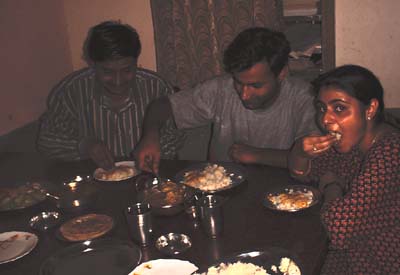
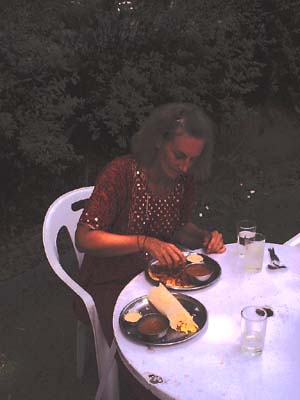
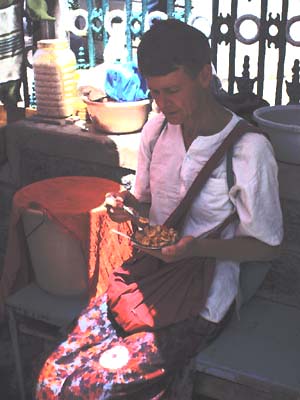
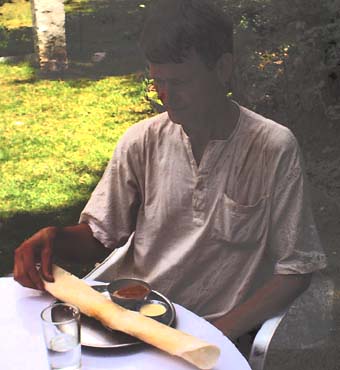
Before diving into a description of the actual delectable eats, I thought I'd paint a picture around the meals. Robert usually says that 1/3 of the world eats with tableware (forks, knives, spoons), 1/3 with chopsticks, and 1/3 with their fingers. India is in that third that finds part of the enjoyment of eating to be properly mixing and scooping the food into the mouth with fingers. Right hand only. That's important, as the left is reserved for certain unclean activities. Our friend, Christian, a well-traveled Indophile, has taught us the technique of squeezing a bite of food together on the plate and scooping it into the fingers, then, using the back of the thumb, pushing it into your mouth.
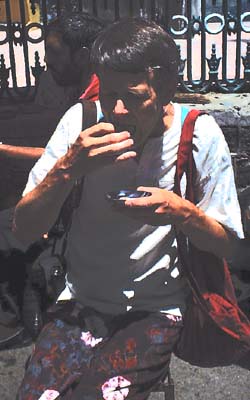
When we traveled to India in 1995, I hesitated about half a minute before I joined Robert in eating with his fingers. Something deep within me says "not to play with my food". Maybe that's why I hesitated. Maybe that's also why I dug in! I should mention also that every restaurant and every home's dining room has a sink for washing before and after the meal. In the finer restaurants, a fingerbowl of warm water will be brought after eating. You can usually get a spoon to eat with if you ask. But you might change your mind when the waiter takes a spoon from his pocket and polishes it with the (often) dirty towel that hangs over his shoulder.
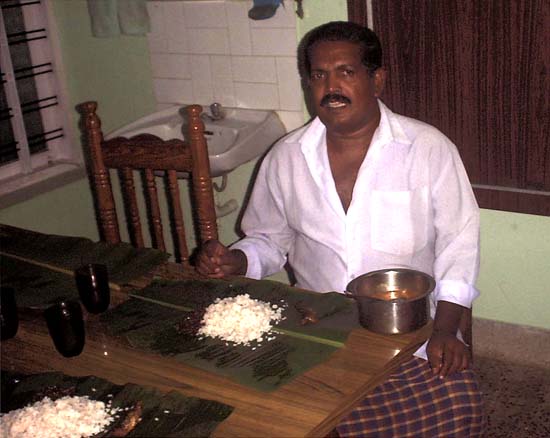
A treat we experienced sometimes in southern India was having the meal served on a palm leaf. These are freshly picked and washed, then spread like huge plates. After eating, the "plate" is simply tossed out for the cows to lick clean. It's wonderfully sensual for the eyes and fingers to eat from a palm leaf … and environmentally sound.
I also want to mention the beautiful metal vessels that are used for serving and eating from. Different sizes and designs of plates, bowls, trays, and drinking glasses are made of stainless steel. They're quite lovely, and when the whole table is set with them, it makes a nice display.
India is probably the best country in the world to be a vegetarian. We've heard one statistic that 60% of Indians are vegetarian ... and we think that may be conservative. For the non-vegs, chicken is most common, then mutton (sheep and goat). Cows are very holy to Hindus, so beef is not eaten. Pork is forbidden for the Moslems. We're vegetarian at home, and have a strong preference to be veg when we're abroad, so this is perfect for us.
We relish in the fact that, in India, food is always available. There are hawkers that sell in the trains and buses ... spicy snacks, ice cream, refreshing fresh, peeled cucumbers, cold drinks, samosas, pakora, tea ... And I want to mention that tea, being such an important part of life in India, is always served freshly prepared. In the trains that sometimes means that the vendors carry portable "stoves" with open fires and two pots, one for the tea and one for the milk. These are heated separately, then poured into a glass with sugar. Two glasses are used to pour the tea back and forth, mixing it well. A definite aficionado’s dream ... all at the price of 2 rupees (ca. $0.04).
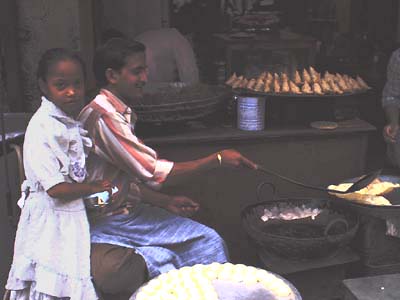
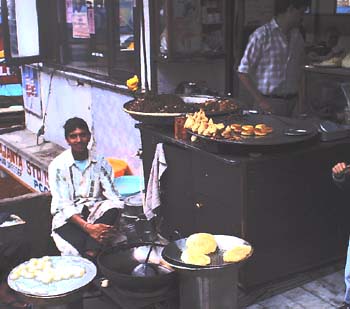
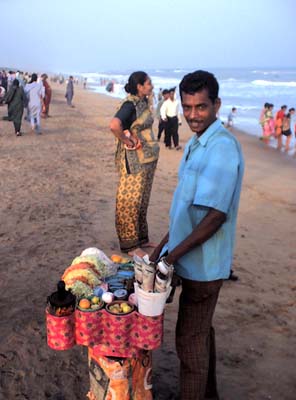
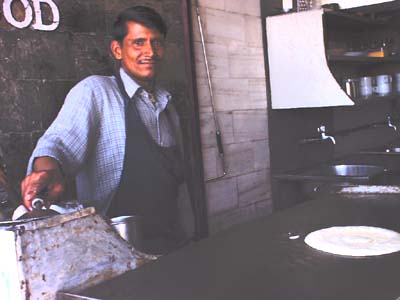
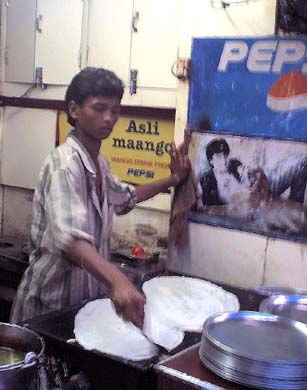
Food stalls line the streets. Vendors are set up at the beach and at temples and at any site where there are people ... and there are people everywhere. In some places, "restaurants" appear in the streets in the evenings after traffic slows down. These are usually complete with portable kitchens, washstands, tables and chairs. We've had some of our best meals at these friendly places.
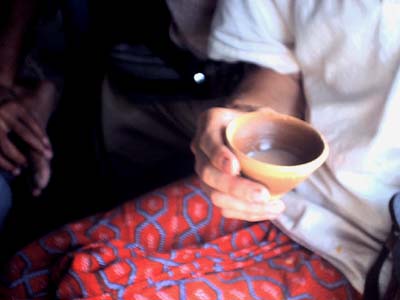
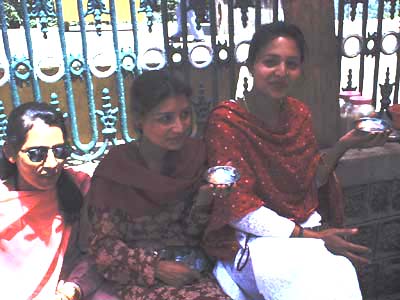
In some parts of India, we get tea, curd (yogurt-like), and ice cream from train and street vendors in simple pottery vessels. Incredulously, this pottery is intended for one-time use and then tossed. It seems such a shame, but such is the availability of cheap labor in India. "Use once and toss" when it’s earth-to-earth is a great improvement over the plastic cups and bags in gay colors that line railroad tracks and streets in too much of India.
I've digressed long enough … Now to get to the subject of food, one of the passions of the world. Big topic. Where to begin?
With breakfast, perhaps, since that’s the first meal of the day. Ah, yes, and we do have opinions about breakfasts. Much of India tries to serve us white toast and jam or an oily omelet. We found what we like … specifically southern Indian, but we sometimes find it in the north, too. This, our favorite breakfast, is idli. Idli is a steamed "cake", about the size of a small doughnut, made from a fermented batter of soaked and finely ground rice and urid dal (an Indian lentil). It’s very refreshing. This is served with coconut chutney and, as with all meals in southern India, a small bowl of sambar (a spiced toor dal soup). Another treat we had for breakfast in southern India was a steamed "cake" of rice and dried coconut. Wow! This was excellent! It seems to be a specialty of Mary’s alone, since we never saw it again.
Breads or Roti
India has a variety of breads. They’re unleavened, mostly of wheat. These are chapati, naan, poori, paratha, kulcha … In Kashmir, we got "Kashmiri bread", and Ladakh has it’s own Tibetan bread. Some of these are fried with oil or ghee (clarified butter), and some are baked in earth ovens alongside open flames. They’re as good as the chef is who made them. Sometimes they’re tasty, sometimes bland … always a good accompaniment to scoop up or sop up the vegetable and/or dal dishes.
Beverages, or "How to Replace Body Liquids in the Most Pleasurable Way"
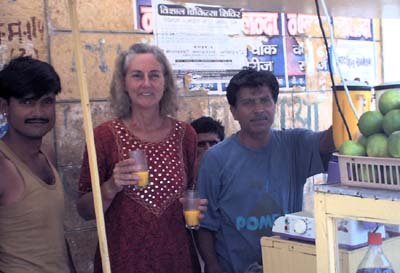
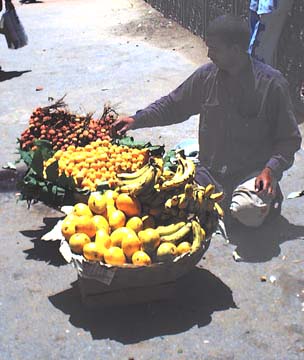
One of the great benefits when we travel in a country with lots of cheap fruit is that freshly squeezed fruit juices are often available.
Snacks, fruits, and sweets
We survive a lot of long bus trips by buying fruit, usually bananas and oranges. The mangoes are plentiful and wonderful, … papayas, pomegranates, coconuts, melons … Now cherries and lychee nuts (mmm!) are in season. A new fruit for me is jackfruit (chakkar). Actually, I’ve seen this often in tropical lands, but I don’t recall having tried it before. We liked this quite well. The jackfruit is a strange-looking growth. It sprouts directly from the trunk and branches of the tree on a short stem. The fruit gets quite huge, as big as a watermelon. The outside looks something like a hand grenade. On the inside, seeds are spread throughout, about the size of a jalapeno pepper. The edible fruit is sectioned around each of the seeds, about the size of a plum. Yellow. Quite good.
We love to try the different snacks in India. Street vendors often have dried chickpeas, peanuts, or other chewable delectables coated with a variety of spices. E.g., freshly made potato chips, extra thick, coated with chili powder. A new snack experience for us we found first in the streets of Calcutta. There, I saw a street vendor surrounded by several women and children, so I stood close by, not attempting to hide my interest. The vendor had an assortment of condiments and spices … fresh onion bits, dried nuts, popped rice, chopped cilantro, dried chickpeas, dried coconut flakes … salt, chili powder, cumin … The women were calling out how much of each ingredient as he added them to a large tin, then squeezed fresh lime over all, and mixed gently. This was poured into small bags (made of cleverly folded newspaper pages) and handed around. My interest in the process earned me a taste, too. We’ve enjoyed variations on this theme many times since, several times on trains and beaches.
A special treat that friends in Dehra Dun introduced me to is GolGappa … or "water balls". These are thin, hollow, puffed pastries about the size of golf balls. They’re filled with chili water. As you might imagine, you have to pop the whole thing in your mouth at once and close your lips before biting down. And then, Wow! What a hit! Now that I know what they are, I search them out in every town.
Another treat is Chaat. This seems to vary a lot, and I’m still tasting and learning. Basically, this is a small plateful of cubed fruit, vegetables, some pastries, or a combination of these. A dressing of tamarind paste and chilies, sometimes mixed with curd, is poured over the top. To be eaten with a spoon.
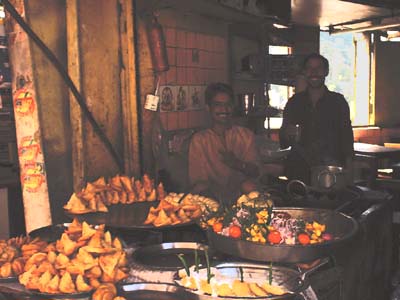
Samosas are the "fast food" of India. We often make a fast meal of these, although they’re officially a "snack". A circle of pastry dough is wrapped around a spoonful of cooked, spiced vegetables, shaped into a pyramid, and deep-fried. These are very tasty, and 2 or 3 of them are enough for a meal. Pakora, bhaji, and stuffed peppers are other deep-fried "snacks", similar to samosas.
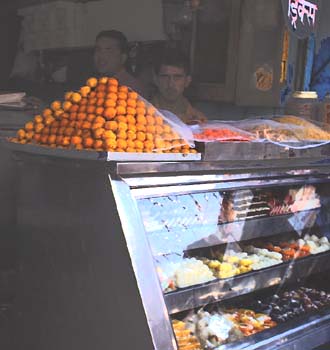
Indians love sweets, and there are sweet shops galore. The sweets are often made with condensed milk, drained curd cheese, or powdered lentils and nuts. They’re sometimes covered with a thin sheet of decorative, edible silver leaf. Although Robert and I seldom eat the sweets, we have had one dessert in southern India that I liked very much, called khir or payasam. This is a pudding of vermicelli cooked in condensed milk, with cardamom and pistachio. Mmmm.
Meals
For a good, hearty meal once a day, order a thali. These can cost anywhere from Rs. (rupees) 20 to Rs. 50 ($0.50 to $1.00). This is usually the most inexpensive way of eating a full meal, and the plate is refilled as often as you like. The thali plate is divided into several sections or it’s a large tray-like plate with several small bowls accompanying … with rice on the large plate and the bowls filled with 2 or 3 vegetable dishes, sambar or rasam (soup), dal (lentils), curd, chutney, and pickles. A papadum often accompanies. That’s a crunchy, thin lentil "bread".
Some of our favorite typical dishes
Basic spices and herbs
Cardamom, coriander, cinnamon, ginger, cloves, cumin, turmeric (which is the source of all those yellow spots I can’t get out of the tablecloths), tamarind, chili, saffron, "curry" leaf, mint, mustard seeds ...
Curd
I’ve mentioned "yogurt" or "curd" several times, but it’s so important that it needs a special mention. It fits so nicely into meals in different ways. It makes a wonderful drink, lassi. It’s great for breakfast, with fruit and muesli or granola. As an accompaniment with thali meals, it’s nicely refreshing. As a main ingredient in many northern Indian dishes, called panir. And in sweets, it’s drained and mixed with such as carrots, nuts, cardamom, and saffron.
So, why do we continually lose weight? Beats me!
Heartily and happily, Namaste – Surain