Since the last travel letter we have left the searing hot plains and moved to the upper regions of Uttar Pradesh, the most populous state in India, dominating the region of the Ganga river.
Corbett National Park
India has many wildlife sanctuaries to protect the dwindling wildlife of a country famed by the British invaders for such animals as the man-eating tiger, the deadly poisonous cobra, and the plumes of the peacock to name just a few. When Surain and I visited India four years ago, we visited several national parks heavily frequented by tourists bused around the park – a far cry from the wildlife experiences we had had in Africa.
But one of my finest memories from a previous visit to India 25 years ago was to Corbett National Park, India’s first national park and one of its best. I wanted Surain to experience the wildlife of India as I remembered it. Battling Indian bureaucracy we finally managed to get a two nights permit for sleeping in a dormitory inside the park.
A sambar (200 kilo deer) greeted us at the entrance to the park and chattering common languor monkeys were everywhere. At a large watering hole a large fat crocodile lazed away in the hot afternoon sun. The number of visitors to the park is limited to about 50, since there are no more beds available, cars cannot drive at night and wildlife has to be watched at sunrise or sunset. We enjoyed meeting the few other tourists there and sharing wildlife experiences.
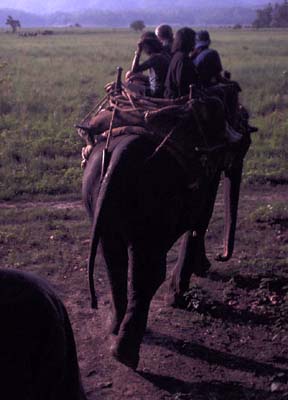
Excellent guides are required for all wildlife watching. Jeeps can cover large areas and can often spot more animals. Elephant rides can take you to dense forests where no jeep can go and you also get closer to the animals. An elephant ride is an excellent way for watching wildlife, which seems to have been abandoned in other parks in India, maybe due to heavy tourism. It can also be very rewarding to spend a couple of hours in a watchtower.
We did all of these. From jeeps we saw sambar, cheetal (spotted dear), barking deer and hog deer. Several kinds of monkeys were everywhere, we saw a peacock in all its plumes, and the rare mating of tortoises. Some people may not be excited by that, but the guide certainly was – this was the first time he had seen that. At one place we were silently hoping that a tiger would show up, but then suddenly the rare jungle cat came strolling by the jeeps.
Our finest memory of the wild elephants was from the watchtower. At one point we could see over a hundred of them in one group, and there were several other groups visible at the same time. Six elephants sauntered by quite close to the watchtower.
Sitting on elephant back we walked right through a huge group of cheetal. These limber, beautifully spotted deer were not afraid of the elephants at all. We were on our way back to camp when we could hear the warning calls of the barking deer. Both they and the sambar give out a warning call against predators. Not far from us we could hear the snarl of a tiger. There were two elephants with riders moving close to a watering hole, where tigers often show up. We waited in silent excitement. Would the tiger show up? Though Corbett is not known for its tiger sightings, there had been many lately. Would one show up? No, it decided to stay away this time.
Still, we were not disappointed. We had never expected to see a tiger in the first place, but were thrilled to have experienced not just one of India’s finest parks, but also one of the world’s finest.
Mammals spotted
Reptile/amphibians spotted
Birds spotted
The source of the Ganga River
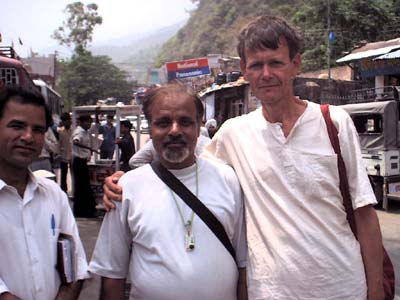
We were not going to do any trekking. We did not want to carry heavy clothes, boots, etc. during a mainly hot weather trip for six months. At least these were our intentions. Then we met Mr. Puri during a bus ride in Kerala. He is a trekker, climber, and mountaineering outfitter. He invited us to come and visit him in Dehra Dun in northern India. Still we were not going to do any trekking.
Two months later found us in Pelling in Sikkim, in the same mountaineering environment where we had met almost 23 years ago. To the incredible backdrop of Kanchenjunga (the world’s third highest mountain) were lush rice fields, villages with friendly people and trails waiting to be explored.
Two weeks later we were welcomed into Mr. Puri’s home in Dehra Dun. He showed us climbs he had done to 20,000+ foot mountains and his mountaineering outfitter company. When he told us we had to go trekking in the Gangotri region and gave us the equipment we needed, we had no resistance but accepted without question.
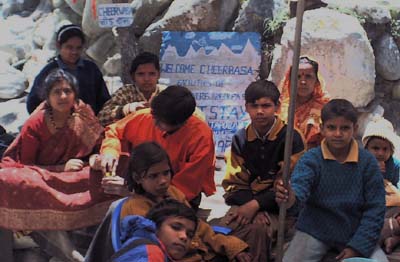
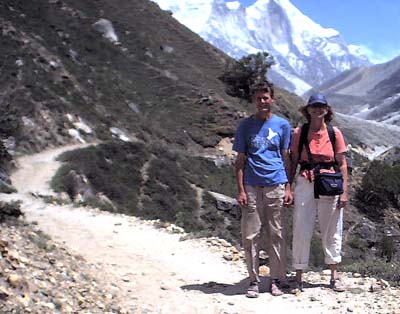
A twelve-hour bus ride through tortuous mountain roads deposited us to Gangotri, the beginning of the trek 3,050 meters above sea level. We were far from alone. Thousands of Indians do the same trek to reach the source of the Ganga river. Sadhus (holy men) start their walk much further downstream in Rishikesh where Ganga reaches the plains. Most of them walk barefoot as well. This takes them at least two weeks.
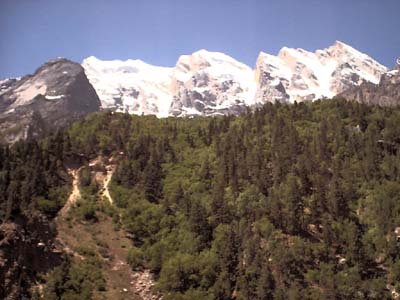
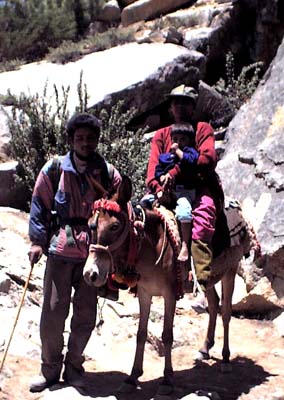
Beautiful Himalayan mountain scenes started unfolding as the trail climbed out of the town. Porters, guides, and pony drivers had in vain offered us their services, but we chose to walk on our own. Most Indians were not used to trekking and chose the ponies. We were most fascinated by the many sadhus in their colorful attire (usually orange). Many were old and struggled up the mountain. Some could not see or could hardly walk. But for many, this is the trek of their lifetime.
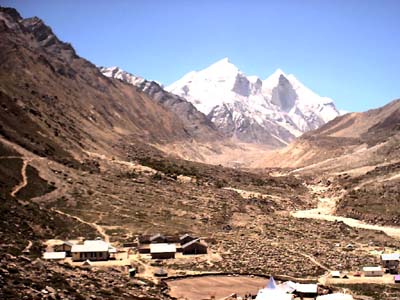
Higher and higher we climbed until we reached Bhojbasa in mid-afternoon, 3798 meters high, after 14 kilometers of trekking. Here the Himalayan peaks were all around us with the Ganga headwaters in front.
We spent the night in the simple resthouse here. Thick blankets protected us from the bone-chilling coldness at this elevation. But the next morning was breathtaking with little atmosphere to block the crispness of the sun. As we had done many years ago in Nepal, we watched the sun high up in the mountaintops, while it took more than an hour before it reached down to us to blanket us with its warming rays.
There were four kilometers further to the Gangotri glacier, where Ganga is born 4,000 meters (12,000+ feet) high. Here horses could not go, and most Indians walked in sandals in difficult rocky and sandy terrain.
To avoid another icy night, we walked all the way back to Gangotri, 23 kilometers for the day. The sandals (Chacos) that we wore were excellent, but against sharp rocks and sand they are still only glorified sandals, and our feet took a beating.
Downloading Pictures from our Digital Camera
It’s great to have this digital camera, so we can share some of the things we see while we travel. But is it really so easy to use? Did you notice that there were no travel letters for a long time, and then suddenly there were three in a row?
Downloading pictures from cameras without a floppy disk (which we do not have, since those are heavier and bulkier), can be frustrating. On paper it sounds easy. Find a computer that has (1) PhotoShop or similar software with Twain32 installed (2) has a serial port. Sounds easy, but isn’t always. In Varanasi, where we finally downloaded the pictures for travel letters (5), (6), and (7), we spent almost two days running around between various internet cafes and being delayed by frequent power cuts.
Maybe you will have an even greater appreciation for the pictures the next time you look at them (and yes, next trip we will have a digital camera with a floppy drive).
Namaste – Robert