Namaste from Dehra Dun, 24 May 2000 We’ve moved far and experienced many
different stories since our last report. O, what shall I say? How do I impart
some of these wonders to you?
Running from the heat of the plains (over 40°
C. every day, often 44°, and up to 47° = 104°-115° F.), we traveled north along
the east coast of India, through Calcutta to Sikkim.
Every travel, every stay has its own stories.
The people have changed, their facial features, their attire, the means of
transport, the food, the balance of religions. The sarees and dhotis are draped
differently in the different regions. The weave of the fabrics (often locally
made silks) differs.
Since Puri in Orissa, we’ve been using
bicycle-drawn rickshaws for much of our local transportation. Oh, how these
thin, strong men work hard as they push the pedals. I watch their backs, the
sinews of their muscles sharply defined in the sweat-soaked shirtbacks. And
none of the cycles have more than one gear. What a boon it would be for these
men to have another gear or two to help them along. Has anyone tried to
introduce this feature? At first I worried that we were an unusually heavy
load: our 2 western-fed bodies laden with 2 backpacks. But we see many loads of
4 to 6 adults hanging precariously onto the back and sides, seated on any
available square inch. The cycle rickshaws are also used for moving freight.
The most common transport for millions of local people, I no longer have guilt
sitting in a cycle rickshaw. The cycle rickshaws are less noisy and much less
polluting than the auto rickshaws (which we hear are being replaced with
electric vehicles in Kathmandu because of the pollution … hurray!), and we’ve
come to appreciate some advantages afforded us in riding them also. We forsake
the hazards common to the pedestrian: cow pies, garbage, fast-moving vehicles, darting
pedestrians, dogs, cows … It gives us a slightly higher vantage point (a great
way to watch the colorful life in the streets and shops), and the beggars’
hands can’t as easily dart out at us (always discomforting).
I don’t seem to have any problem with finding
something to say once I get started … but let me fast forward to Sikkim. We
have some pictures to show you.
Sikkim is one of India's states, but it feels as
if it’s another country. Part of the Himalayas, Sikkim is squeezed between
Nepal to the west, Tibet to the north and northeast, and Bhutan to the southeast. The
people are more of the Mongoloid features, with Nepali and Tibetan heritage.
Robert and I met on a trip to Nepal in 1977 and have wonderful memories of the people. Being
in Sikkim transported us back with some of those memories. The men were often
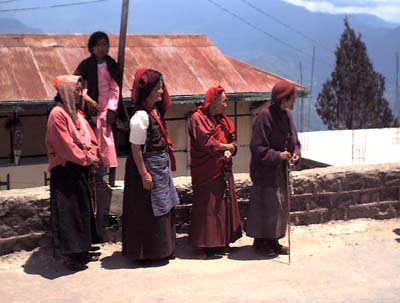
in the baggy-crotched, narrow-ankled pants, tailored jackets, hats narrow,
straight-sided, and boat-shaped (how to adequately describe?). Women wear an
apron of finely-woven, many-colored horizontal stripes over a mono-colored,
long dress with bodice wrapped one side over the other. Bearers carry
tremendous loads on their backs hanging from straps across their foreheads. In
most other parts of India, loads are carried balanced on top of the head … often colorful
jugs, huge baskets, or bulging bundles tied with colorful cloths. This
difference likely has to do with the steepness of the terrain that people have to
negotiate with their loads. Most of India is flat … or at least much flatter
than the Himalayas. Using the tops of heads to carry loads can be done in a
very straight posture. The steep slopes in the Himalayas have to be negotiated
with a bent lunge forward.
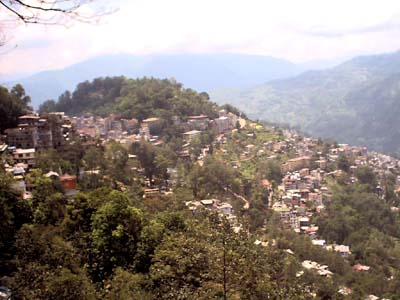
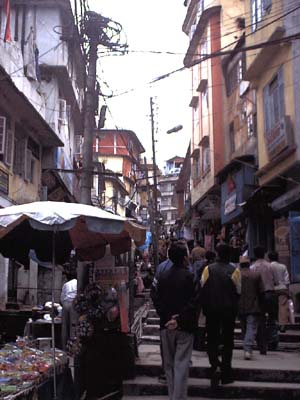
In Sikkim, we traveled first to Gangtok, the
capital of the state. As Robert so aptly puts it, Gangtok is like a city turned
on its side. There are no rickshaws here. Even the auto rickshaws don’t have
strong enough engines to negotiate these inclines. Here, the jeeps rule. The
roads wind with hairpin turns, and narrow, precipitous stairways provide the
pedestrians a shorter route up the hill.
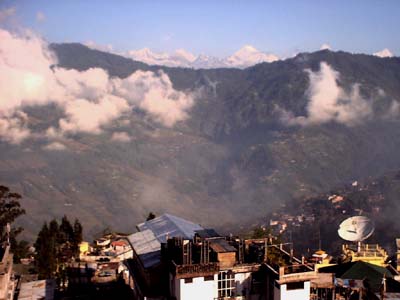
Our hotel had 8 storeys with the first floor
entry on one street, and the 8th floor was level with the next
street behind. The views of the Himalayas were incredible. We could see
Kanchendzonga, the world’s 3rd highest peak at 8,586 meters, from
our hotel room.
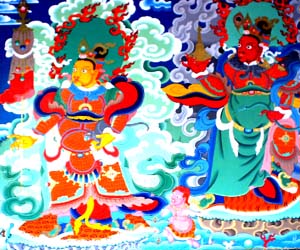
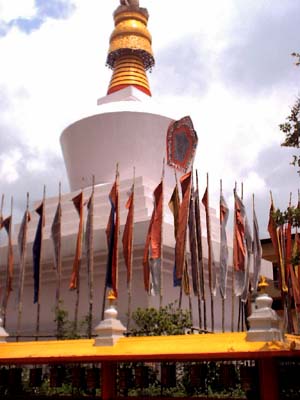
Buddhism is prevalent in the Himalayas. We
visited several monasteries, stupas, and chortens, gaily painted with stories
of deities and Buddha’s life.
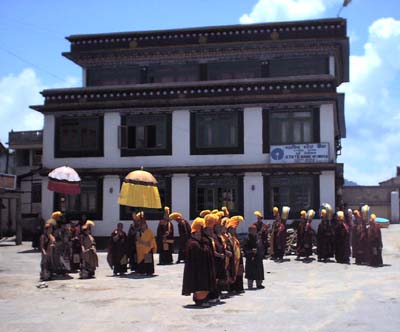
At the Rumtek Monastery we were lucky to see
a ceremony with the monks in special robes and headdresses. As we joined the
"parade" of people streaming through the temple gates into the
courtyard, we were met with two men in masked costumes. They were dancing in
place, and one was spraying everyone from a barrel of water. The other danced
around a flame that jumped high and hot. What gaiety … We were unable to find out what
the occasion was, sorry to say, but enjoyed it nevertheless. (We later learned that
this to celebrate the beginning of a 10-day puja, to honor the Karmapa, the leader of the
Black-Hat Sect of Tibetan Buddhism who had fled from the Chinese rule in Tibet this past
December. He will later take up residence here at Rumtek.)
Sikkim has to be in our future travel plans.
It has wonderful trekking opportunities. The mountains are incredible; the
landscape is awesome (dozens of wild rhododendrons and orchids, hundreds of
bird species); and the culture is colorful and friendly. We loved it. It’s less
"spoiled" and touristed than Nepal is now reputed to be. What more
can we say? We highly recommend it for a visit, whether you’re interested in
trekking or not.
So why didn’t we stay longer? We often wish
it had worked out to do so, but we needed to move along. Two things: We weren’t
equipped for the mountains … and … we were trying to meet up with Joan Yuen, a
friend from Seattle. We’d had an email that she would be in Darjeeling, which
is just south of the Sikkim border in West Bengal.
The road between Pelling, our last location in Sikkim, and Darjeeling was down,
down, down, up, up, up, winding through the
villages splashed on the hillsides, hairpin turn after hairpin turn. The
Indians love proverbs, and we regale over them in train stations, along city
roads, and on these winding hill roads. Here’s a sampling:
Bus and then jeep over roads that sometimes
didn’t seem as developed as a cow trail, we finally arrived in Darjeeling … in
a downpour of rain. Darjeeling, of tea fame, sitting high up on the top of the
hills, surrounded by tea plantations. Darjeeling, the famed British hill
station, is still a glorious city, but is aging and crowded and dirty. We
negotiated the winding hillclimbs, working our way to the hotel where we hoped
to find Joan, darting from overhang to overhang, hoping the rain would let up.
We were hovering under one of these shelters, when suddenly Joan walked up!
What a welcome sight! We also met Petra, Joan’s friend from Germany.
We stayed in Darjeeling just a couple of more
days. The moisture and coolness was wearing on all of us, so the four of us
headed south, back to the heat of the Indian plains. First to the Buddhist
pilgrimage center of Bodh Gaya and then on to Varanasi. For those great travel
memories, we’ve got another report coming to you …
Until then, Namaste and Good Health – Surain
and Robert
with stories from Sikkim, 1-7 May 2000