April 2000, Puri, Orissa
Namaste from Robert
It is always fun to read Surain’s stories and relive what we experienced one or two weeks ago. Could I already have forgotten what happened? But then there are SO many things happening in our lives right now. I’m afraid this will be a bit drier report, my impressions aren’t as vivid as Surain’s.
Bus and train travel
Yes, you have heard about it before, but let me give my take on it. I sometimes wonder if it is worth going through the hassle to get train reservations, to wait in endless lines, and then there may be no sleeping berth available. Is it really worth it? Why not just hop on a bus, like almost all Indians tell us. "So much easier" ... ?
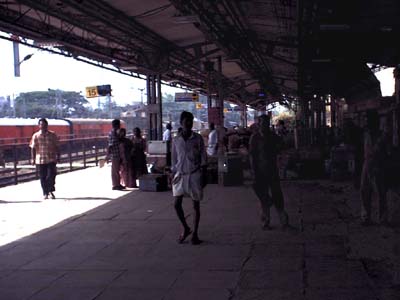
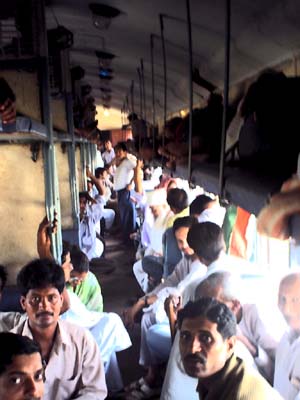
At one place in Kerala (now a long time ago), we did just that. Rather than taking a long rickshaw ride to the train station, we hopped on the nearby bus. It left 7 am and would take one hour to the next train station. The bus arrived promptly and we got in. There were no seats available so we had to stand; in fact, it was so crowded we barely got on. Where I was standing there were some grain bags on one side and people pushed from the other so I almost fell over. With both hands holding on to a bar in the ceiling it was only at sharp turns that I almost fell over. To get the money out to pay the ticket, I needed both my hands and hoped the bus wouldn’t turn a corner right then, it would have toppled me against the next passenger! But I did not have to pay, the bus did not go where we needed to go! Did we get on the wrong bus? – we don’t read Malayalam, the local language. So we got off and then on to an equally crowded bus, and then a third one. Then an auto-rickshaw took us to a train station and we could regain our sanity and resume train travel! (But we are now in the north where trains are more crowded and buses less, so the scale may start to tip a bit for short travels – for long travels it is definitely the train).
Puri, April 26-29
There are several places in India where tourists like to "hang out", where they relax from some of the trauma that travel in India can involve at times. So we searched out one of those oases in Puri in the state of Orissa, just south of Calcutta on the east coast of India facing the Bay of Bengal.
Puri was like a sleepy seaside resort, a place almost devoid of people. There were several hotels, all of them almost empty offering very low rates. It was as if everybody except us had understood that this was the hot season, not the season when you travel to India.
But I had visited Puri a long time ago (23 years!) and remembered it quite differently. So in order to find out if the city had changed so much I walked from the tourist area to the town center. And lo and behold, here everything was very different!
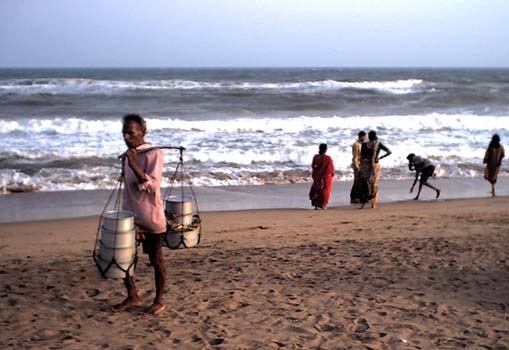
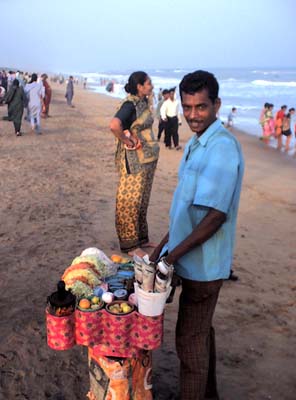
Indian hotels lined the road and the wide beach on the other side teemed with life. Lots of Indian tourists were at the water’s edge, walking along the water and into it, falling into it, laughing, and having a good time. It was too rough to get far into the water, huge waves crashed onto the shore. People were riding horses, there was food and paraphernalia vendors everywhere. A few cows found their way onto the beach to join into the fun. This was the India we loved, not the boring tourist areas.
The streets were very narrow, so it was a pedestrian’s paradise with a few bicycle rickshaws. These alleys led up to the Jagannath Temple, one of the holiest in India. Surrounded by a market, there were food and temple items everywhere, cows roamed the streets, sadhus (holy men) headed for the temple. In true Indian style, some were completely without clothes. Non-Hindus are not allowed into this temple, but a convenient library was located right next to it. Its top floor offered a commanding view of the temple.
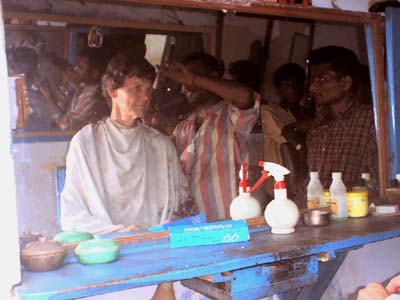
After two months of travel, my hair was getting longer and longer. Urged by Surain and others, I finally succumbed to the razor of an adept Indian barber. He did a good job, and my only complaint was that he cut it a bit too short.
The Orissa Super Cyclone
Does the name Orissa sound familiar? Last fall there was a devastating cyclone that descended on Orissa. They call it "super cyclone" here, to separate it from regular cyclones. I remember death tolls being quoted as 20,000 to 30,000. The Indian newspapers now put it at 80,000. There have been many relief efforts, but the Indian government still does not have a plan for distributing most of the help effort. And thousands are starving.
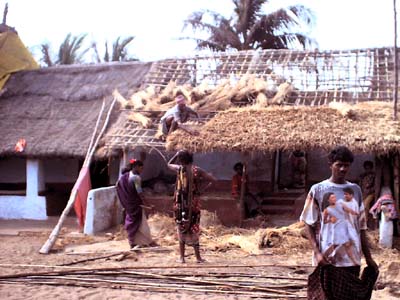
Puri, at the edge of the cyclone was spared, but a fishing village next to it was not. Most of the mud brick homes were razed to the ground, leaving people without shelter. We talked to a man furiously trying to build a new concrete home. He was fighting against time to have it completed before the onset of the monsoon rains, which will arrive around mid-June. Lack of funds give him no hope to finish it in time.
[He asked us to help in the reconstruction, but we are not carrying money to help the multitudes of people that ask for it. And yet, the plight of this man seemed real. He only asked for $20-$30. If only five of you reading this send him $5 each, his goal would be reached. To do so, send it to Vaddu Vijaye, c/o Pasar V. Mohanrao, C.T. Road, Puri ORISSA, Pin 752002 at his bank account: 2253, ODI BIJAJ RATNUM, Penthkota Noliasah, PURI-2. Do not mail him money, the mail is routinely opened to clean it of cash. We visited him on April 27.]
Konarak is one of the most famous temples in India and is a World Heritage Site. It’s about 30 kilometers from Puri, and the bus there drove along the Bay of Bengal, now a devastated area. I won’t bore you with more temple talk, but it was amazing to see how the swath of the cyclone had cleared almost all trees on the ground, how there are still branches lying everywhere; no villages left at all.
From Puri we headed
north to Sikkim … See the next story.
Namaste – Robert