Thursday, 20th of April 2000, from Hospet, Karnataka, India
Namaste to our friends, once again -
Whew! It's so hot. I sometimes wonder if that tickle I feel on my forehead is an insect or sweat. When the salty moisture runs into my eyes and smarts, it confirms that it's sweat. One day this week, it was 44 degrees Celsius. (For reference: we keep our hot tub at 40 degrees Celsius, which is 104 degrees Fahrenheit.) But it's at least a drier heat now that we're inland versus the humid heat that we experienced along the coast of Kerala. There were some dramatic lightning and thunderstorms with torrential rains, too. But, no, everyone says, it's not the monsoon yet. So, what must monsoon be like?
Insects did I say? This morning, Robert woke up with so many mosquito bites on his throat and upper chest that it was impossible to count them. (I had put on repellent, so I wasn't similarly decorated.) We've been sleeping on the roof the past few days. It's wonderful. Cooler than indoors. The moon is full, and the stars are bright. It's wonderful. We actually haven't been bothered by mosquitoes as much on this trip as I'd feared, but something else is finding my plump, pink flesh to be most attractive. I often find gatherings of red bumps the size of nickels on my legs or arms. I don't think it's bedbugs; we're using our own sheet-bags. I think something finds its way under a shirt sleeve or under my skirt while we're on the buses, and then it concentrates there while I'm concentrating elsewhere. Fleas? Spiders? No-see-ums? Shudder.
We're now in Hospet, staying with the parents of a friend in Seattle, Vidya. His parents lived in the States for almost 30 years, and moved back here after retirement. It's most interesting to talk with them to get their thoughts comparing the U.S. and India. Sastry characterizes a major difference by describing how people ride the trains here. When first entering the railroad car, one quibbles loudly with other passengers to move over and give some space to sit down. Within a short while, however, everyone is talking amiably, as if they were old friends. They find some common interests, and immediately, a bond is built. In the U.S., we can live several years without getting to know our neighbors. In India, neighbors become close friends and count on one another to look out for each other. Sastry also says, "The U.S. is a nation but not a society … India is a society but not a nation." Community is an important part of life here. I think that's one of the things that draws us to India. To Robert and I, that sense of community is very desirable.
In the last couple of episodes, we mentioned that we were going to meet up with some Swedish friends. Well, Robert's well-laid-out plans worked. Milena and Katarina arrived in Mumbai's (Bombay's) airport from Stockholm on Thursday morning. They transferred to the train station without ever going into the city, got seats on the train that we'd suggested, and arrived in Jalgaon that evening. We were there on the station platform waiting for them.
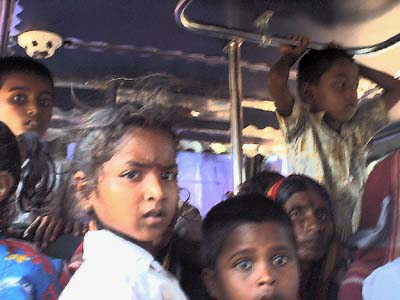
We've had a hard program since then. We visited the ancient cave sites of Ajanta and Ellora on Friday. They're majestic, with many murals still recognizable and some of the colors still there after more than 1200-1500 years. Then we moved further south to the town of Bidar on Saturday morning, where there's a very well-preserved walled fort. The wall has a triple moat around it. We took the bus to Gulbarga that evening, and on Sunday, we struggled our way to Badami. I say struggled. Badami isn't on any major road or railroad route. We always attract crowds wherever we are, especially when tourists aren't common. Well, Bidar to Gulbarga to Badami isn't on any known tourist route. The bus stations are crowded, and we're constantly being stared at and picked at. "Hello, what's your name?" "Hello, school pen please." "Hello, two rupees." "Hello, what is your country?" It's not only children, but young adults, too. It's hot, our packs are heavy, we're trying to find the bus that will take us to our destination. I try to smile and answer, and I try not to get impatient with all this attention. When we're trying to get something accomplished, there's a limited amount of hands that I can shake and attention I can give, I opt to ignore some of these pleas for attention. Finally, our bus comes, and immediately there are 100+ people crowding to get in the door, many are tossing bags in the windows to reserve seats. It's not in our nature to crowd also, but we need to do it if we want to get seats on the bus. Standing for several hours on these bumpy roads and tired buses is not the way we want to pass the day.
This travel, bus and train, crowded, unclean, hot, bumpy, jarring, drawing constant attention, is part of the India experience, and I often have to remind myself of that, and relax. It's okay. But it's such relief when we finally arrive at our destination, find a hotel, and get a cold shower. Aaah!
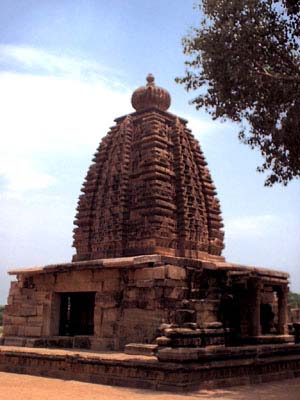
I digressed. Back to Badami. Robert and I were here on our last trip in '95-'96. We like Badami a lot. It's a small town, and very colorful, with its horse-drawn rickshaws, its oxen-drawn, wooden-wheeled carts, pigs and goats and cows throughout the streets, and people everywhere in their colorful sarees and longhis. Within easy walking, we can visit ancient caves and temples on the cliffs overlooking the town. There's a nice tank (lake-like) between the cliffs where people are washing clothes and spreading them on the steps to dry. And within an hour's (ok, maybe it's a bit longer) bus ride, there are 3 more ancient temple sites, one of which (Pattadakal) is a World Heritage site. The ancient Aihole site is within a small village, with much of the temple ruins as part of huts now in use. We walked the streets, attracting the usual attention, and took lots of pictures.
After 2 nights at Badami, we managed to get a train to Hospet. O, the trains are so much preferable to the buses when we can travel that way … room to move our legs, and not quite as jarring.
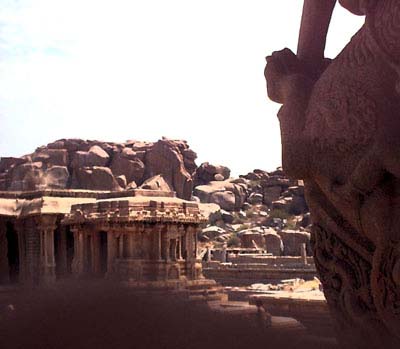
Just a few kilometers out of Hospet is Hampi, another World Heritage Monument. We hadn't known about it in advance, but we arrived just in time to see the biggest temple celebration of the year at Hampi. It occurs on the first full moon after the Hindu new year (which was April 5 on our calendar this year). The temple "cars" are paraded down the "bazar", drawn by hundreds of people, and accompanied by thousands more. These "cars" are not at all like cars we drive on the roads, other than having 4 wheels. They're more like huge chariots, several storeys high. These particular "cars" were about 5 storeys high. An elephant led the parade. Musicians and dancers accompanied it. And crowds and heat … Whew! It was an incredible experience! I'm so glad we were here.
Friday, the 21st, and we're still in Hospet …
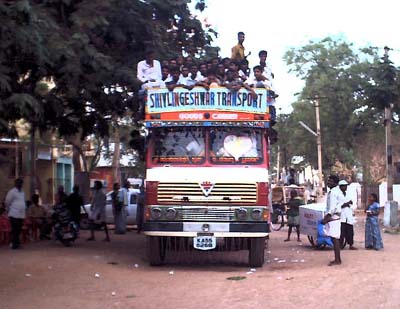
It seems that this is wedding time. There are specific periods of the year, and only specific days according to the horoscope which are auspicious for weddings. It seems that half of the year's weddings must be occurring today. We've seen trucks and buses loaded with people going to weddings. They have hearts on the front windows covering the passenger side with the names of the wedding couple. Small parades of musicians and gaily dressed people throng the roads. Colorful canopies shade happy parties.
Milena and Katarina headed for Goa this morning. Robert and I take a night train tonight in the other direction, to Tirupati in Andra Pradesh. It's a major Hindu temple just a bit north of Chennai (Madras).
We're still well and happy. Have had some new shirts made (I found a tailor who made one for me in one hour for 20 rupees = about 45 cents). Sent 23 rolls of exposed film with Milena for her to mail to the U.S. for us.
Tuesday, the 25th of April, Bhubaneswar
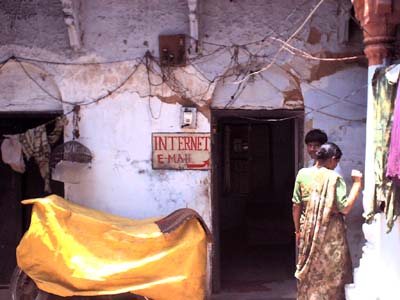
Moving along. Finding internet sites is quite an experience. One time, we had ducked out the back door of a temple to get away from the many beggars who flock like bees to honey when a Westerner is around. We found ourselves in an industrial alley, with small hardware shops around. We'd had enough of temples for that day, so decided to try and find an internet site. This looked like the wrong part of town. I'm learning what people to look for to ask for help when looking for an internet site. Not the young nor the old. A young man or woman who looks like they're educated. If they're on a scooter, that's a good sign. Actually, the best is a young woman wearing a churidar or other popular attire among the young women. A sari is not a good sign. She's probably married and has kids. Well, here we were on this back alley and a young woman suddenly showed up. I ran after her, "Excuse me … Do you know of an internet site around here?" She indicated the building we were next to. Maybe she didn't understand me, but we went inside anyway. "Around the corner and up the stairs" was the hand language we got this time. Did they understand? We went up some steep, narrow, concrete stairs to a roof-top, crossed it through cardboard cartons and wires to a hallway, saw a man sitting on a bench … "Internet?", said we. Right inside the door amongst more cardboard boxes, with cables hanging out of the walls. The computer sites vary a lot from high tech with air conditioning, to the just-described among cardboard boxes with a shakey fan overhead.
India experience year 2000. The internet is everywhere, but finding it is a trip. It's not in the places we'd expect. So, we have to learn the Indian way.
We've found a place today where we could download pictures, so hoping to send this off to you.
Namaste and good night - Surain and Robert