“Vanakkam” from Thekkady, Kerala, Tuesday, the 4th of April
2000
(“Vanakkam” is the greeting in parts of Kerala and Tamil Nadu)
Can you imagine a whole village wafting in the scent of cardamom? Mmmm… It’s heavenly! Cardamom!!! Perhaps I should explain some, since cardamom is not a common spice in America. It’s used often in Indian cooking, but that can be misleading, as it’s usually part of a mixture of spices so the cardamom flavor itself isn’t distinct (although cardamom tea nicely highlights it’s flavor). Cardamom is also often used in Sweden, particularly in cakes and cookies. Swedes call it “the spice of the Gods”. If you aren’t familiar with cardamom, you really should seek it out, smell it, and then crush and add just a few seeds to some black tea. Mmmm …
We’ve spent several days in the hill country of Kerala, at Munnar and Thekkady (Periyar Lake). It’s more beautiful than we had imagined. The greens of palm trees, evergreens, tea plantations, coffee plantations, orchids, bougainvillea, and many, many other plants and trees covers the steep hillsides. The bus winds back and forth, switchbacks after switchbacks, up, up, up, then down, down, down, then up, up, up again. Switchback after switchback. The bus driver gets incredible exercise spinning the wheel back and forth. And, of course, the especially loud horn blaring at each switchback and at each vehicle, dog, and person met along the road is a necessary driving aid … but more about that later.
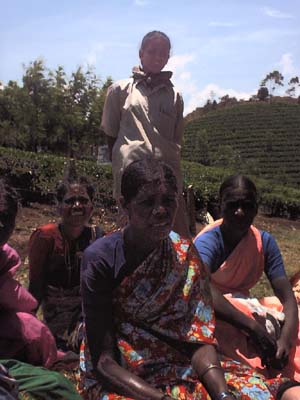
We’ve walked among the tea plantations several times. One time, we sat in some shade to have our lunch and were joined by a group of women tea pickers taking their lunch break. They tied my hair back to keep it out of my face. They giggled and passed our binoculars and camera around, looking through them (or trying, as they insisted on keeping a “buffer zone” from the eyepieces). Then they showed us how to pick the tea leaves. Just the top three leaves, the newest growth, are picked. Each tea bush is thus picked only once a year, during the 3-month period before the monsoons. They’re paid about $2/day (60-100 Rupees), which is fairly good pay for the workers. For example, a typical big meal in a restaurant will cost about 15 Rupees.
We also took a long walk among coffee and cardamom plantations. So many heavenly spices are grown here … cardamom, pepper, cinnamon, cumin, coriander, fenugreek, asafoetida, cloves, nutmeg, star mace, sesame seeds …
Thekkady and Munnar also have several national parks nearby. At Periyar Lake National Park we had some great sightings of wild elephants and at Eravikulam National Park we saw several nilgiri tahr (an endangered ibex). There’ve also been some incredible bird sightings … red-whiskered bulbul, pond heron, anhinga, cormorant, egret, kingfisher, grebe … Some of you will want to know what kind of kingfisher, what kind of grebe … Wish I knew.
Elephants are still used in India for heavy work. We’ve seen them in timber yards. They’re an important part of temple festivals throughout the year, and they’re used for heavy work the rest of the year. What a sight to see an elephant lumbering down the road, and it’s treated as an everyday happening by all the drivers who simply honk and swerve around them.
O, yes, I said I wanted to talk about the honking. I’ve got this song running through my head (Am I safe to assume you all know the tune to: “These boots are made for walking … and that’s just what they’ll do …”?):
These horns are made for
honking,
and that’s just what they do.
All through the day, these horns
are gonna blast you through and through.
We met a woman who recently married a young man of Indian heritage from Seattle. She’ll be moving there in July to join him. I told her that if she is going to drive in the States, she should know that the horn is used very differently there. In the U.S., a honking horn means someone is angry. In fact, with “road rage” and the freedom of anyone to have a gun, I think honking is very dangerous and is only done at risk of death. In India, honking is truly a part of driving, and is probably an important part of driving lessons. The horn indicates that you are passing or about to do so. Traffic is left-handed in India, but that’s mostly important to remember when facing head-on to oncoming traffic with each of you at breakneck speed, and at the last second you each must swerve to the left. Other than which side to pass oncoming traffic, the vehicles are all over the road and often fill it from curb to curb. (There are seldom curbs outside of cities, but you get the idea anyway, eh?) I’m starting to get calmer about the driving here, but there are so many “close calls” in each and every ride that I still cringe and tuck to cover my head at times.
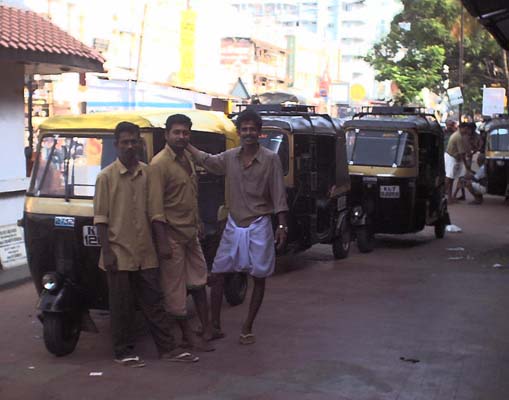
Really, traffic is incredible here. It fascinates me, and I have taken on a respect for the drivers. Roads are filled with so many different vehicles and creatures, at widely varying rates of speed, and going in many different directions. There are very few traffic lights, and yet traffic seems to move along quite adequately, and we’ve only seen one accident. (If anyone tried to drive like this in the States, it’d be instant chaos and wipe-outs.) There are buses, trucks (lorries), auto rickshaws, motorcycles, bicycles, ox-drawn carts, man-drawn carts, people, cows, goats, dogs, chickens. What have I left out? O, yes … elephants. The vehicles whiz down the road, honking at anything that moves and at each approaching bend in the road, passing anything moving slower than they are. Thus there are often 3 vehicles going in the same direction, with the middle one passing the outer one, and the inner one passing the middle one. There’s likely to be a pedestrian or two at the side of it all, too (Robert and me, for instance). If there’s an oncoming vehicle, it only breaks at the last second in rare instances. Usually everyone makes it with the outer vehicles slowing or breaking.
The auto rickshaws are a story unto themselves, and we ride in them quite often. They’re amazingly versatile, and it even seems that they’re flexible, although I know they don’t actually flex. They simply maneuver so adeptly, so quickly. They’re 3-wheeled, with scooter engines. No, I say no more. I can’t do it justice. You must experience it yourself.
It’s now Saturday evening, the 8th, and we’re in Ernakulum (twin city with Kochi). Tomorrow we go back to our friends in Karumalloor, Mary and Johny, for a last visit before we head north on Monday. Next week, we meet up with 2 friends from Sweden, Milena and Katarina, and visit some sites in Maharashtra and Karnataka.
We’re doing well, have had only small hints at intestinal problems, getting tanned (seeking shade most of the time actually), and enjoying ourselves. We hope you are all doing as well … and not working too hard, eh?
Namaste – Surain and Robert