Rajasthan
July 2 – 18, 2000
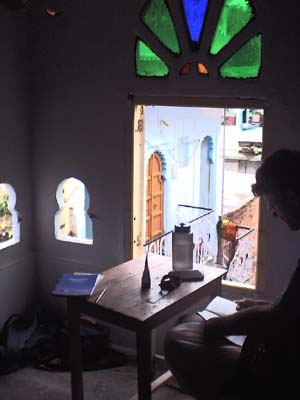
Namaskar dear friends and family -Living in the havelis in Udaipur is even cozier and more intimate-with- the-neighbors than on the houseboats of Lake Union … much more so, I should say. We’re sitting in our room with its little seating nook cantilevered over the ground from two floors up. Little windows are on the three external sides, small windows not much bigger than our heads, sculpted and arch-shaped holes in the wall, with shutters for cover.
The man in the neighbor haveli is only 12 feet (ca. 4 meters) away. "Namaskar." … "Namaskar." The woman who owns this guest house lives up another stairway a few feet away, and she looks over and bids good morning and invites us over for tea. While laying in bed earlier this morning, we could hear the splashing of someone bucket-bathing. It sounded as if they were in our bathroom … and then we found that the outdoor bathing area for the next building is only a few feet away. It wouldn’t be difficult at all to leap across to the neighbor’s haveli.
This seems as good a place as any to tell you about part of the routine morning cleansing among the people of India (especially among the men) that we find rather unpleasant. It’s a clearing of the throat, and even the whole sinal-esophageal system, by deeply gagging and spitting repeatedly for several minutes. This is not particularly enjoyable to hear first thing in the morning, but it’s easy to forgive as the day moves on.
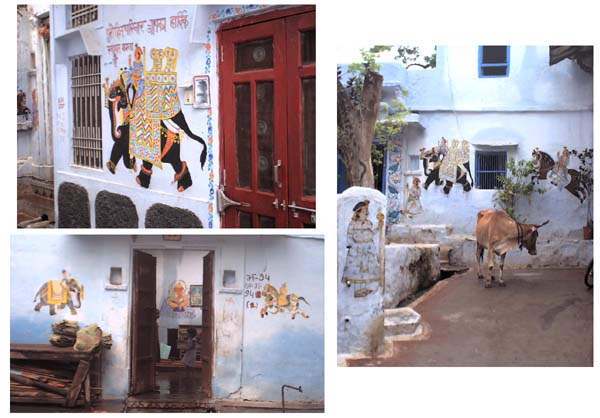
So what’s a haveli? This is a 3- to 5-storey house built around a shaded communal courtyard. Most were built by the merchant class, and since Rajasthan was on a principal trading route between east and west, the merchant class was quite wealthy. Windows and doorways are often magnificently sculpted and arched, and finely detailed paintings of animals, maharajas, and flowers decorate walls.
The havelis of the ruling class were ornately finished with finely carved stone and wood façades, eaves, balustrades, and screens. Screened balconies allowed women who must remain out of public view, a tradition called "purdah", to observe the events in the street.
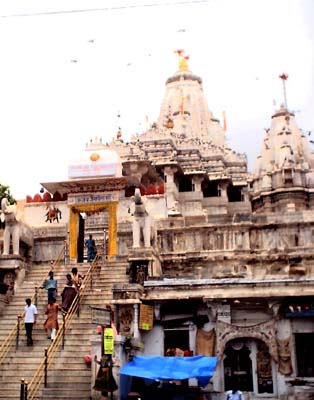
Udaipur was a fantastic surprise to me. It’s a delightful old city with a honeycomb of small streets and alleyways to wander around. There are countless temples dotting the skyline, white marble palaces "floating" in the lakes, and colorful bougainvillea gracing walls throughout.
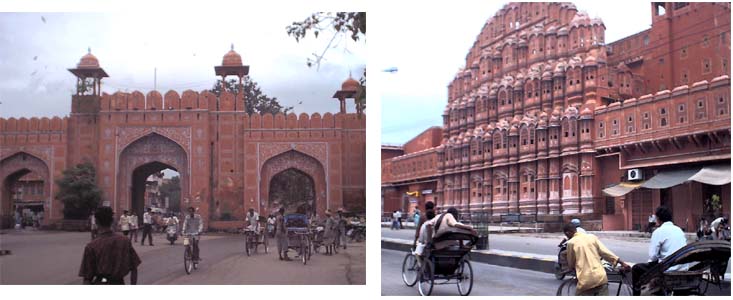
We’ve arrived here as part of our Rajasthan wanderings. There aren’t enough superlatives to do Rajasthan justice. When you come to India, you must visit Rajasthan. Perhaps it’s the extreme hardship of the desert that has spurred the peoples of this region to build this highly decorated and colorful society. The buildings are lovely … Jaipur is known as the "pink city", since many of the buildings are built with pink sandstone, harvested from the semi-arid areas nearby, and a soft pink paint is used to harmonize the market areas.
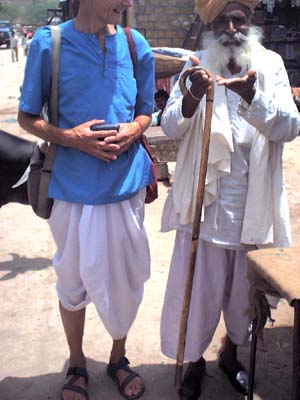
People’s attire is a feast for the eyes. As one Indian said to me, "The clothing and culture changes every 10 km." In northern India, the men wear their dhotis wrapped so that each leg is draped separately. Robert’s dhoti, bought in Kerala in 1996, finally was so spotted and had been repaired so many times that it was time for a new one. So he bought a new one here and was shown the local way to drape it. He looks great! The locals love it and call him "Dhoti Man". I can promise you, any other tourist so garbed is few and far between, if at all.
With the unbleached white dhoti and an unbleached white kurta (shirt), the men wrap colorful turbans on their heads – bright saffron, coral, pink, or tie-dyed with accents of greens, blues, and oranges. This is the only place in India we’ve seen turbaned men other than Sikhs. The turbans are wrapped a bit differently, and, with the other attire, there’s no mistaking a Rajasthani villager from a Sikh.
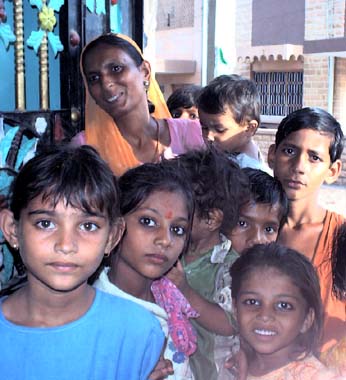
The women’s attire is also quite different from elsewhere. The colors are brighter. Perhaps this developed to contrast the single tones of the arid landscape – from the soft pink sandstone to beige soils to the soft golden sands of the dunes. Instead of the sari found in most of India, village women wear long, gathered skirts called ghanghra. The blouse, a kurti-kanchali, is usually similar to the blouse worn with saris. It’s short at the midriff and tight in both the bodice and sleeves. A long, billowing scarf of a brightly colored, lightweight cotton, chiffon, or silk is draped over the head and shoulders and around the waist, then hangs to the ground at one end. The scarves frequently cover their faces also, in purdah tradition.
Jewelry is used head to toe. Chains with pendants drape on the foreheads and necks, elaborate rings hang from the ears and noses, arms are covered with colored bangles from the wrist to the elbow and wide, white rings from the elbow to the shoulder. (Traditionally, the white rings were of elephant tusk ivory; now, plastic.) Huge silver bands are worn at the ankles and, as in all of India, there are several toe rings. A toe ring on each foot signifies that the woman is married; but the fashion is "the more, the merrier" (toe rings, that is ... not husbands). Everything is ornate and elaborate. Lots of silver is used, and gemstones are a specialty of Rajasthan.
A constant sorrow of mine is that I don’t have pictures (or very few) that show these different clothing styles from, not only Rajasthan, but of all of India. Believe me, they are a feast for the eyes. India seems to specialize in decorating to make things beautiful and in highlighting to make the most of that which is already beautiful.
But I cannot lift up my camera in someone’s face and shoot. I just can’t do it. I don’t like to sneak either. They usually know about it. Now, if I’m taking a picture of a lovely building or a cow in the road and someone just happens to walk by just then … well, so be it. I shan’t pass up that opportunity! If the situation is such that I can ask their permission, I’ll do it. And frequently they’re very pleased … However, then they usually put down the baskets so gracefully balanced on their heads, or they re-arrange themselves neatly in a line … not exactly the natural setting that I’d wanted to capture, but nonetheless … And sometimes they say "no" by turning away or waving their hand back and forth. In those instances, I regret if I have offended them by making their appearance the object of my interest, but I’m glad that I asked and I then comply with their wishes.
Rajasthan. I’m glad we saved this to the last part of our trip. This is the India of fairy tales and dreams. (And, by the way, of the best, spiciest food yet!)
But … getting here was not a dream.
The Road to Rajasthan
You may remember that we were last in Ladakh. That’s quite a ways north of Rajasthan, but we arrived here in little more than four days of land travel. The landscape quickly changed from austere, high mountains, to lush green vegetation with rivers and waterfalls, to hot desert plains.
O, but what four days! First, I will refer you to Robert’s great description of the 2-day bus ride from Leh, in Ladakh, to Manali (see the Ladakh travel report, #11). That’s a famous/infamous trip amongst travelers, a "must do". One sees landscape of rock formations and stone mountains, high mountain passes so austere that not even the intrepid yak grazes there. And, then, after crossing over several mountain passes, there are lush green mountainsides dripping with waterfalls. Oh, but what two days those were … sitting on a bus all day and crawling into an unfamiliar tent in the dark and sleeping in our clothes on the dirty mattresses with a well-used, tattered, thick quilt tucked under our chins. But sleep we did, as we were tired. But Robert has described the wonders of the Leh-Manali road. I shall move ahead to the following two days.
We stayed one night and one day in Manali to comfort our bodies a bit before boarding the next bus – an all-night bus trip to Chandigarh. It was dark shortly after we left Manali, and we entrusted ourselves to the driver and his crew as we were lulled to sleep in the rock-and-roll motion of the bus winding down, down, down from Manali at 2000 meters south to the plains. Oh, I have one more road proverb – just one more, I promise. I hope someone out there reading this gets as much of a kick out of these as I do. If it’s not you, bear with – it’s only one:
Anyway, sleep we did. At least I did. I have this knack, both advantageous and disadvantageous, of easily dropping off to sleep as soon as I’m in a moving vehicle. Robert doesn’t suffer this same affliction, so the night bus rides aren’t as favorably looked upon by him. But he, too, eventually dozed. Suddenly, in the middle of the night, 3 AM to be precise, the lights came on in the coach. We were by the side of the road, and the driver’s assistant was instructing us that we had to get off the bus and onto another. Dazedly, we gathered our belongings and jerkingly hauled them with us as we stepped off the bus into the darkness. Indeed, there was another bus alongside, and we obediently re-packed ourselves into that one. The bus-load of people from the second bus was herded into our first bus, and each headed off in opposite directions. Times such as this I wish I could speak Hindi and find out what this was about. Did one of the drivers suddenly remember it was his wife’s birthday and he’d better return … ??
I sat down to make myself comfortable, and the seat under me felt as if someone had crumpled crackers all over it. So I brushed it off and took one of the "crumbs" for closer inspection. This required a flashlight. Then I could see that I had a number of small cuts on my hand and the "crumb" in my fingers was broken glass. I looked around and spoke with a man nearby. Lights were turned on, and we saw that broken glass covered the seats and floor all around. One of the windows was shattered and a few sharp edges still hung in the window frame. The broken glass was brushed into the walkway, and we settled down to sleep again. The rest of the night proceeded uneventfully, and we were duly dumped in a parking lot in Chandigarh at 5:30 AM.
As soon as the railroad ticket office opened, we managed to get reservations for that night’s train from Chandigarh to Bikaner, in northern Rajasthan. Aah – our destination of Rajasthan was only one more day away. So we stored our backpacks in the station cloakroom and explored this city for the day. (Spent 4 hours on the computer, visited a wonderfully unique and entertaining "rock garden", had lunch in one of the city’s finest restaurants, and even had time for a routine blood test.)
Our train was to depart at 10:20, so we got to the station around 9 PM and found some chairs. By 10:00 I was somewhat concerned at the low level of activity on the platform, and by 10:15 I said something to the man seated next to me. "Train to Bikaner? It’s canceled today." Awk! We quickly dashed to the ticket window. There was a crush of people there, but all for a different train than we were interested in. Everyone seemed most sympathetic, and they regrettably looked at the clock and told us it was too late to take the 1-hour bus trip to the next town where our train could be caught in half an hour. Someone finally explained that there had been a train derailment earlier that day that had meant this disruption. I found a notice posted, in Hindi of course, with all this info.
So what to do? Here we sat at the train station several kilometers from town, late at night, with no train going to our destination until the next day. So, change our destination. We had been planning on a Bikaner to Jaisalmer to Jodhpur to Udaipur to Jaipur routing through Rajasthan. There was a train at 1 AM to Delhi, and our trusty train schedule book showed that we could make a connecting train to Jaipur at 8 AM. So, we could reverse our route plans in Rajasthan. This sounded like a good plan. Back to the ticket window where we were assured that there would be sleeping berths available when the train to Delhi came (there were).
While we waited for the 1 AM train, we studied our map of Delhi. There are several train stations there, and the train to Jaipur left from a different station than the one we would arrive in (naturally). It seemed to be only a few kilometers between stations, so we figured that the timing would be within comfort. When we arrived in Delhi the next morning, we jumped into an auto rickshaw with instructions to take us to this other station where we’d catch the train to Jaipur. This driver had another plan for us however, and he took us about 100 meters to a bus stand. There ensued some heated debate about the best way to get to Jaipur, and we flagged down another rickshaw (#2) and were off to the train station. After a kilometer or so, this rickshaw stopped. Something was wrong. "Just 5 minutes," said the driver, as he disappeared down the street. We waited an anxious 5 minutes or so and were becoming worried about the time; so we flagged down yet another rickshaw (#3). This time we made it. I was worried for a minute, however, because where he dropped us, in the middle of a street vegetable market, there was no railroad station visible. When I questioned him, he indicated it was through the archway at the end of the street. The fruit vendor next to us concurred. On the other side of the archway, there did seem to be some buildings with tracks beyond, so we quickly walked this way then that, looking for ticket sales or an entrance. We were directed to a small building completely surrounded by bamboo scaffolding, and we ducked in. There was a long line at the ticket window, so I took advantage of the Indian system of letting women go to the front of the line (yes! … completely!). "No," I was told … the train we wanted (our trusty train schedule had supplied us with the train number and time) wasn’t. The next train to Jaipur was hours hence, in the afternoon. I appealed forlornly (as if the ticket taker could conjure up the train just for me) and was referred to the Inquiry window. After some discussion there, we learned that the train we wanted was on Saturdays only. Hmmm … Someone had forgotten one of the lessons we had learned about the train schedule some months ago. Hmmm … What to do?
Find a rickshaw (#4). I’ve neglected mentioning thusfar that, with each rickshaw driver, we must first negotiate a price. Delhi is notorious for overcharging foreigners. This is a battle in all of India, but Delhi is particularly bad, bad, bad. Many tourists start their travels there and are still unfamiliar with prices as they should be and not yet used to thinking in rupees. For instance, these rickshaw drivers might start by asking Rs 120, and the price finally settled on was Rs 40 ... undoubtedly still too much.
So rickshaw #4 was supposed to take us back to the first railroad station, with the bus stand across the street. But … Yes, it happened … It ran out of gas … and there was no petrol station nearby … and there weren’t other rickshaws passing by. So he says, "Just 5 minutes … wait here." He didn’t seem to know which way to turn, pacing up and down the street; so when another rickshaw came by, we gave the first driver (#4 actually) a few rupees and left him in his distress. He’d be soon on his way. He was probably better off, in fact, without us as "baggage". So rickshaw #5 delivered us to the bus stand (but around the corner from the first ticket seller … We wouldn’t want him to see our defeat, after all.)
The bus would be there in "5 minutes" according to the ticket seller, but we waited and waited. It must have been closer to 50 minutes (maybe the ticket seller didn’t know the word "fifty" from "five" in English), but the bus eventually came. After we boarded, the bus wandered here and there picking up other passengers for another half hour before we actually were on the road to Jaipur. And without further mishap, we arrived there in the afternoon and got a very pleasant hotel with a nice garden courtyard.
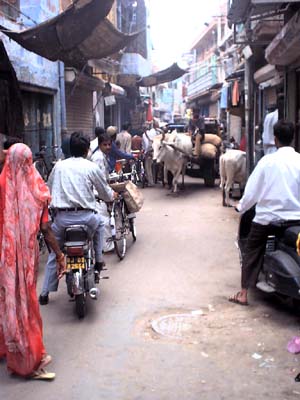
Rajasthan … where camels pulling carts share the streets with bicycle rickshaws, auto rickshaws, buses, trucks, cars, scooters, bicycles, pedestrians … the occasional elephant, and of course the omnipresent cows.
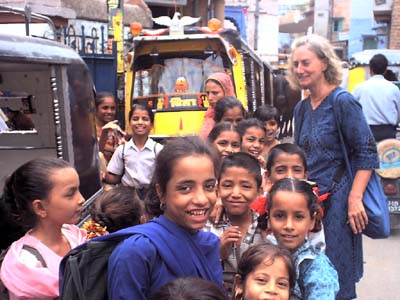
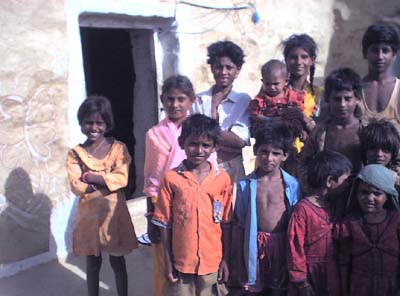
… and children love to try out their English (usually limited to "Hello" … "What’s your name?" … "Give me pen" … "Give me chocolate" … "Give me rupees", and our policy is "Have no …")
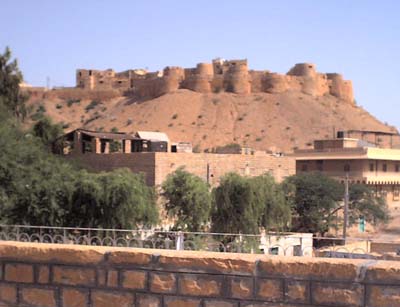
We visited Jaisalmer, in the western arid part of Rajasthan, where the city is at one with the desert.
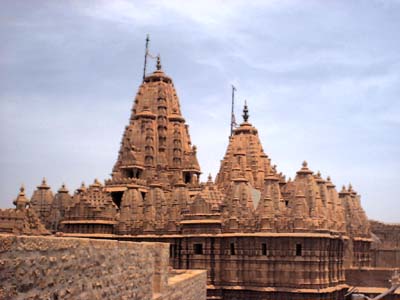
About half the town still lives within the fort walls, with its narrow streets and many temples.
It was very tempting to take a several-day camel safari and sleep under the stars. We talked with a number of travelers who did it. All reported that the camel ride wasn’t very comfortable but that sleeping under the stars out here where there was only darkness around was awesome. We opted for a half-day jeep safari that visited some ancient archeological sites in the desert and some villages.
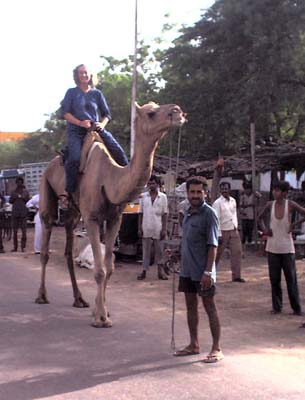
The culmination of the safari was at the sand dunes where we rode a camel out the dunes to watch the sunset. The beginning and ending of a camel ride are nail biters. We mounted the camel while it sat on the ground. It stands by straightening first the back legs and then the front. Can you picture the long legs of a camel? Can you imagine how tilted a camel would be when only the back legs are straightened and it’s still kneeling on the front legs? Then can you imagine how it feels to be seated on the back of the camel? Gulp! Hold on for your dear life! By the way, all the while it’s changing positions, the camel is moaning and wailing as if in extreme pain. It’s quite distressing, but this seems to be normal camel behavior.
Rampura
Let me now tell you about the day that definitely is the highlight of our India trip … and certainly shall be one of the highlights of my life.First I will tell you about a small, private group in Seattle, to which Robert and I belong, People for Progress in India (PPI). PPI contributes 1 to 3 years of funding through NGO (non-governmental organization) partners in India to help begin self-sustainable projects among the less advantaged. While in India now, we’ve visited three of the local NGO’s to learn more about the work being done and, in two instances, to visit the villages where the PPI projects have been carried out.
In Jodhpur, in Rajasthan, we met Sashi and Laxmi Tyagi, founders and leaders of Gramin Vikas Vidyan Samiti (GVVS), the Village Development Scientific Organization. They’re quite remarkable people and have compiled a team of other remarkable people to work with them.On Monday, July 10, we accompanied Sashi on a long trip by jeep (about 250 km, about 3 ½ hours each direction) to a village where the third year of a water enhancement project is underway, funded by PPI with volunteer work contributed by the local villagers. A total of 20 khadins and 13 taankas are being built.
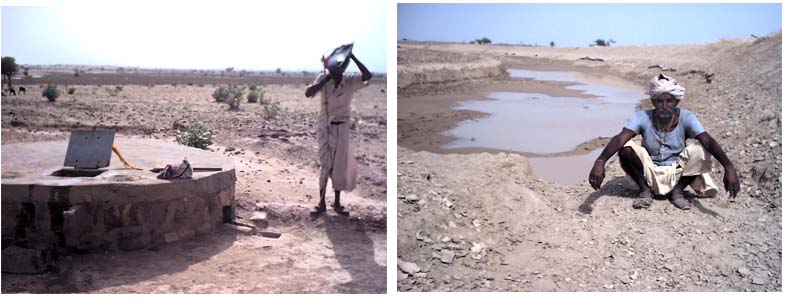
A khadin is a system for rainwater catchment and field irrigation, consisting of 1) a low-height bunt, or dam, in a curved shape with 2) a shallow trough between the bunt and the field; 3) a spillwater in the bunt for run-off of excess water; and 4) the water pan and crop field, which is several acres.
A taanka is an enclosed storage tank, about 10-15 feet deep and 10 feet wide, with a hatch about 2 x 2 feet for access with a bucket. Rainwater drains from surrounding land into the taanka.
We saw one of the completed khadin and met the farmer who works it. He had farmed the same land for many years, and, with the new khadin, the yield was four times the prior yield. A new field season had just begun, and a few green shoots were visible.
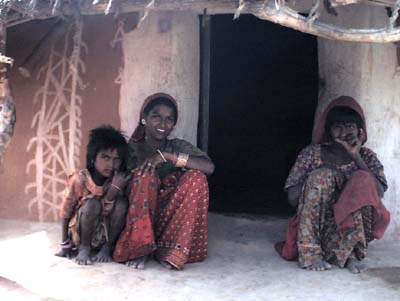
We also went to his home where we met two daughters and saw the taanka that was built with PPI funding.
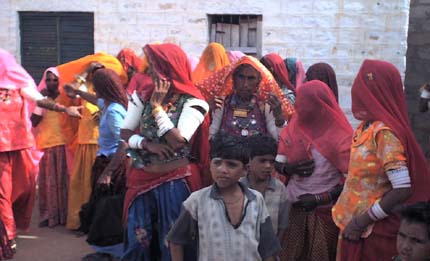
Then we went to a village home where we were greeted by about 20 women. A warm welcome had been planned for us!! The women were all dressed in their finest bright-colored dresses, with their heads and faces covered by their shawls in purdah fashion. They gathered in a tight group and, while singing a "welcome" song, they slowly inched towards us, also a sign of welcome. Following this, our necks were garlanded with flowers and one of the women dipped a thumb in a red liquid and painted a red line down our noses and a dot on our foreheads. It was a tremendous honor, and we were both quite emotionally moved.
We sat and visited for about half an hour (Sashi interpreted for us). They discussed the many ways that GVVS has helped the people in this village (~1500 people). As the designated and trained health worker received a replenishment of supplies for her medical kit, she very adeptly went through the supplies, one by one, and described what ailment each was used for and how the treatment was applied. These were such as tablets for indigestion to bandage wraps for wounds. Despite being illiterate, this woman impressed us with her ready familiarity with each (there were at least 10 different medicines) and comprehensive discussion of each treatment. She had been well trained (by GVVS volunteers) and was obviously bright.
The visual scene in front of us unfolded as we talked. Hands started opening the shawls and smiling eyes peeked out at us. From foreheads dripped the family’s finest fancy pendants. Ornate nose rings and ear rings further decorated the lovely faces. Arms were covered with bracelets from wrist to shoulder. Eventually most of the shawls fell to their shoulders, and interchanges warmed up more and more. The spokeswoman for the group, a serious, handsome woman, presented a list of seven desires of the group:
Sashi spoke to them at some extent, and then translated our response that we would work to bring some of this help. This brought exuberant claps and smiles.
As is the way, we met separately with the men. From them, we heard more praise for the benefits that have been experienced and discussion about the projects yet to be done.
GVVS has several centers established in the arid lands, which serve many villages in each area. We visited two of these centers, the largest which had a staff of about 20. There were growing grounds for a plant nursery, school buildings and teachers, a medical dispensary, administrative center, and facilities for staff and guests to live.
The center which served Rampura was about 15 km north of Rampura, at Shiv. This center serves 15 villages and over 20,000 people. They served us one of the most fantastic meals we’ve had in India … most fantastic because every ingredient was locally harvested. We had 1) millet chapatis, 2) kahejadi, a bean which grows on undomesticated trees in the arid lands, 3) a dish of tomatoes, onion, and curd, 4) gwar, a crunchy, dried bean, 5) a glass of curd, and 6) leddu, a wonderful dessert made of ground seeds (post) with raisins and nuts. This was a tremendous honor.
Finale
We'll end our India 2000 stories here. We aren't going to tell you about our visit to the national park at Bharatpur that is one of the world's best bird sanctuaries, which was much beyond my furthest hopes. It was fabulous! (Ask us.) And we're not going to tell you about our five days in Delhi, this incredible city with many wonderful beautiful and historical sites to see and with the hustle-bustle microcosm of India in the streets. (Ask us.) I'm already feeling the pangs of the India that I'll soon miss.We go to the Delhi airport tomorrow night (July 23) for a relatively short flight to Bangkok, Thailand, where we again fly out 5 weeks later (August 28) for return to Seattle. We haven't given the upcoming much thought beyond our first destination: Angkor Wat in Cambodia. Then perhaps Laos, Vietnam ... We're about to begin another 5-week trip actually, and we'll plan that out further on Monday.
Namaste from India, with Cheers and Blessings for the upcoming - Surain and Robert