KASHMIR REPORT … June 10 – 18, 2000
Saturday, June 10, was another day of sitting on a bus over hills and many winding roads. I’ve got some more of these great Indian road proverbs to share with you:
You, dear friends, will have widely varying knowledge of Kashmir. Some of you will have images of beauty and harmony. Others of you may be concerned about the current political-militant situation and its possible intrusion on travel to Kashmir.
Kashmir is the home of the famous "cashmere" sweaters, of the world’s finest, softest wool, made from the chin hairs of ibex goats in Ladakh. The wool is gathered from bushes. Locally, it’s known as "pashmini" wool.
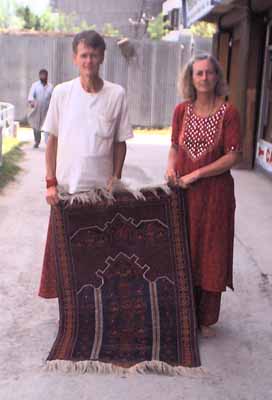
Kashmir is known for some of the finest handicraft work in the world. Not only are there the magnificent sweaters and shawls made from the pashmini wool, there are world-renowned papier mache boxes painted with lovely, detailed designs made by Kashmiri villagers. Some of the world’s most beautiful carpets are woven here … and Yes! we did find one we fell in love with. It’s old and unique. We bargained hard. Here’s a sneak preview of it … Come visit us in Seattle to see it’s full glory.
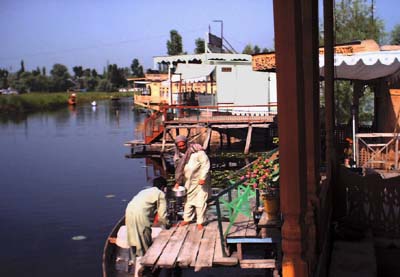
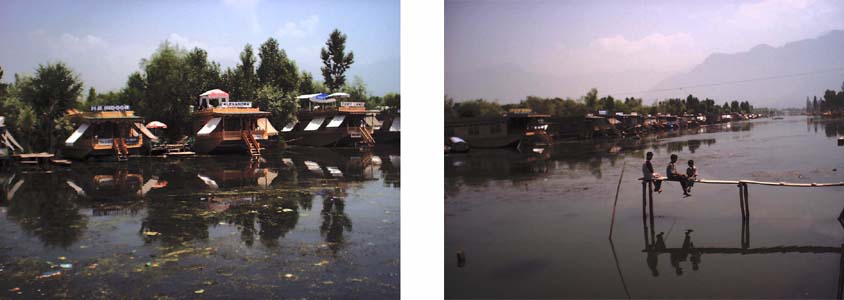
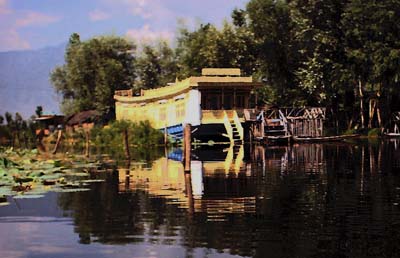
Kashmir is the "jewel of India", British India’s favored holiday spot. Srinagar, the main city in Kashmir Valley, is 1,730 meters (ca. 5,500 feet) over sea level, which makes it a mild climate and wonderful escape from the heats of the Indian plains, plus there is no monsoon. Srinagar is on several beautiful lakes. Dal Lake is the main one, and it was here that the British introduced houseboats. They’re long and narrow and furnished with hand-made mahogany tables, chairs, bed frames, cabinets, etc. The outside terraces of the houseboats are often ornately carved, and there are scenes of animals or plants painted along the bow and stern. Manual labor in India is inexpensive and can produce some beautiful fine detailing.
Kashmir is also known by many these days as a "hot spot" on the terrorist map, and most tourists have avoided coming here for the past 12 years. The border between India and Pakistan has never been agreed upon by these two countries since the British pulled out over 50 years ago. The issue flared up in particular about 12 years ago, and the many travel packages offered in the U.S. and Europe, which brought thousands of tourists daily, dried up. But travelers have started coming back recently, and the word on the travel road is that there is more danger in the bus trips on narrow mountain roads than danger from terrorists in Srinagar. Some areas of Kashmir are more threatening than others (e.g., the road from Srinagar to Leh, Ladakh, which passes only a few kilometers from the disputed border near Kargil). So, when we were able to confirm plane reservations on a flight from Srinagar to Leh and thus avoid that border area, then I felt comfortable going to Srinagar.
So, the winding, hilly bus ride took us from Jammu, south of Kashmir and Srinagar, through the mountains and a tunnel into lovely Kashmir Valley. Green rice paddies. Fields of flowers. (Kashmir is also where some of the world’s finest saffron is grown. This delicate spice is the world’s most expensive. Three or four anthers are harvested by hand from this particular species of crocus, and it takes 4,500 blooms to make one ounce [28 grams] of saffron.) Lovely snow-capped mountains surround the valley in all directions.
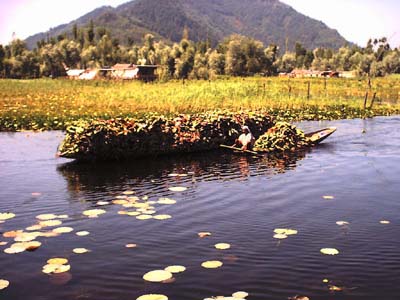
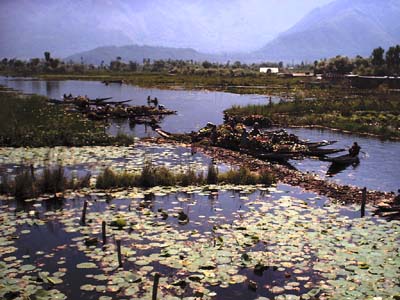
We were ferried to the houseboat, Good Faith, where we lived for 5 days, on a local shikara. These small canoe-like craft are the vessels of life here. We would sit on the deck of Good Faith and, in the mornings, watch the local women pull boat-loads of lily pads from the lake bottom and paddle them off to market for cattle fodder. This is an effective means of keeping the lake from being overrun with water lilies and lotuses. In India, nothing goes to waste.
We were treated like royalty by the Shodas, the family that own the Good Faith. One can sit all day on the houseboat and simply breathe in the fresh air and gaze at the peaceful surroundings. All the services that one could need come paddling to your houseboat. We could buy everything from toilet paper to jewels and gems from vendors who paddled up in their shikaras. Tailors came by with shikaras-full of fabrics from which to select; then they would take your measurements and come back the next day with your finished, custom-made garment. Even the laundry man came by shikara to pick up and deliver our laundry.
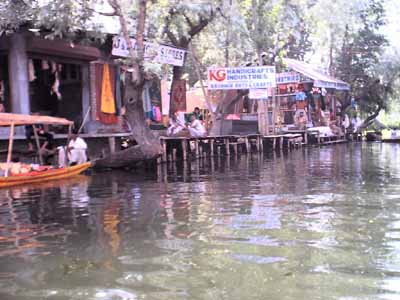
Shopping from the shikara at one of the local shops is also fun.
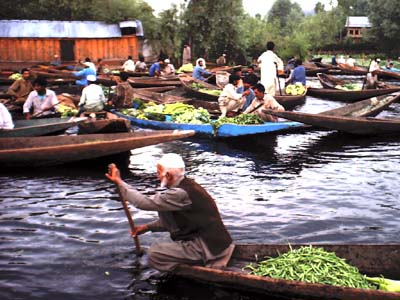
We borrowed the Shoda’s small shikara several times to explore the lake. Thank goodness, Robert quickly mastered the stroke that kept the shikara going in a straight line. I got completely worn out by zigging and zagging back and forth down the water lanes. We joined dozens of villagers on their shikaras early one morning at the floating vegetable market. Cabbage, carrots, cauliflower, gourds, cilantro, basil, corn … everything trades hands in the community method of bartering. Only once did someone fall in as their heavy load shifted from one shikara to another. A great whoop and laughter rippled through the crowd.
Vegetables are grown on floating gardens! Yes! O, I would like to introduce this at the houseboats where we live. I asked how it was that the geese and ducks didn’t graze all the produce. No one could understand the plight that we have on Lake Union. Perhaps there is simply so much garden that there is plenty to go around … enough for the geese, ducks, and human consumption. The gardens are perhaps a foot or two deep into the water and a few inches above. A mass of roots seems to hold the soil together. We saw mostly tomato plants and gourds (squash). Imagine the automatic watering system!
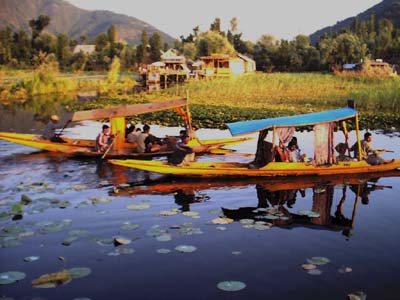
One can also hire a shikara with surrey roof for shade and oarsman, and sit back like a Maharajah. These are like the gondolas in Venice. The Indian tourists are always having such fun! They often travel in small groups and fully experience all the joys around … chattering, laughing, having a gay time. In Srinagar, they would hire 2 or 3 shikaras and paddle them together.
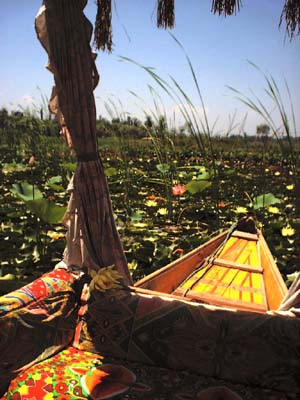
The bird life was awesome to watch. There was a mother grebe with 2 small babies nearby. There were lots of eagles, coots, paddie birds (a smallish, tan and white heron), kingfishers (common, white-throated, and pied), etc. Our stay on Dal Lake coincided with the very beginning of the lotus bloom. Wow! What a magnificent blossom. The lotus, both the leaf pad and the bloom, rises above the water by one to four feet. The flower opens big and pink. All around us, water lilies were in bloom, mostly yellow. They bloom on the surface. Next time, I’d like to come a few weeks later in the season to see acres of the lotuses in bloom. Another water plant shown us here was water chestnuts. Wow! I’ve enjoyed these in Chinese cooking many times … It was fun to see it growing. These, too, are a few weeks from maturity, but the sample taste I had was good, nonetheless.
We were in Srinagar for a total of 8 days, and we decided to try out a different houseboat experience for the last 3 days. The first house we were in was quite big and elaborate and … how can I put it … more "Maharaja"-like than we were exactly comfortable in. It was also situated quite a distance from the central area of the city, which had its advantages (watching the village shikaras, good bird life, less traffic, and more peaceful) as well as disadvantages (more difficult to get to the city, a limited view of lake life). So, we moved to a much simpler houseboat, with wall planks that fit very roughly together and floor planks that needed to be shifted around to accommodate the current need. It was closer to the city and closer to the local village life. We liked trying out the two different aspects of Srinagar houseboat life.
Checking in at the airport to fly out of Srinagar was the most arduous security clearance I’ve ever experienced. We were physically searched three times. Our carry-on bags were gone through with a fine-toothed comb three different times (including opening pens and hand creams) and all batteries were taken hostage (from cameras and flashlights). And our check-in baggage went through several x-rays, and then we had to personally pick out each piece before boarding. ‘Tis okay … I’ve no complaint where my safety is concerned, but the penknife that a fellow passenger had in his pocket that was overlooked by all these checks is a bit disconcerting.
Now it’s the end of June, and we’re in Manali … "back in India" we say to each other. Kashmir and Ladakh (another story) were amazing experiences, both culturally and geographically very different from one another and very different from the "Indian" subcontinent and its peoples. We’ve only got 3 more weeks in India, so we’re on a fast track now to Rajasthan.
Namaste to you all – Surain