Yangtse River, China
11 September 1983
“I had long had it in mind to make a boat
that would skim the waves quick as any bird
Yet never carry people away from their friends
But only carry people back to their homes.”
--- Yuan Mei
Dear friends:
The sun burned the clouds away this morning just in time for
our passage through the first of the steep-sided, narrow gorges along
the Yangtse between Chungking (now Chongqing) and Wahu. The
otherwise patchworked & terraced hillsides gave way to sheer rock &
green slopes too steep to grow crops on. Up, up, up to craggy-tothed
peaks 2-3,000 feet over us.
How does a cruise down the Yangtse sound? Do you imagine
deck chairs & a swimming pool, with a white-jacketed water serving
referencing cocktails? Weelll ….. We don’t exactly have any of those
things. We’re traveling 4th class these three days, but even second
class (there is no 1st class) doesn’t have those luxuries. For about
$13, we get to share a dorm room with 22 Chinese for 3 days. It’s a
great way to travel. There is one man in the bunk next to us who
speaks a very limited English, but he serves as interpreter when
anyone wants to ask a question …. and the crowd grows with curios,
friendly faces ….. the questions continue, and we ask questions back.
From these and other meetings we’ve had with Chinese, we
understand that wages are about $20/month for a factory worker,
about $40 for a teacher. Home & utilities seem to be a standard
$3/mo. With food about $10/mo. Women work right alongside men in
all sorts of work. The workweek is six 8-hour days, with everyone’s
free day varying. There’s no system to coordinate a couple’s day off
together. There seem to be 7 holidays during a year, and there is no
paid vacation. Jobs are more-or-less assigned and there’s little hope
of changing if you’re not satisfied Those wanting to better themselves
are most often left with self-education and television language classes
as the only alternatives. University entrance is extremely competitive
e, with only about ½% of the “high school” graduates being accepted.
There does ‘t seem to be any possibility after that one chance. Some
factories conduct colleges for employees to learn skills that will enable
them to advance within the factory.
One may not freely move unless one wants to move to the
countryside; but not vice versa of from one city to the next.
But everyone is friendly and often smiles. They’re polite and
life is orderly …. Except when it concerns forming a line for anything
…. Forget it. It’s everybody fighting for their own.
I didn’t finish telling about the Yangtse, and now’s my chance.
We were suddenly all taken ashore and transported by bus to another
boat below a dam. The water level is very high, and we’ve learned
that the boats for a few days after ours were canceled. There are
usually 2 which go at the same time daily, “We can only guess that
they don’t want to pass boats through the locks and release any
water. Below this point t, the land beside the river is low and spreads
out, susceptible to flooding. This area of China had serious flooding in
June.
We’ve noticed the flow of the water is incredibly fast. What
takes 3 days downstream, takes 5 days back up. There’s not a calm
spot anywhere, with the chocolate milk-colored water swirling in
strong rapids, eddies, and may small whirlpools.
We’ve seen lots of dead, bloated animals float by; but fish seem to
live in this jucky water. How they see is beyond me.
Now it’s Monday, 12 September
We’ve been in China fo two weeks as of today, and it’s three
weeks & two days since we left Stockholm on the evening ferry to
Helsinki. They ship went through the lovely archipelagos and the
weather was perfect. It was a most fitting way to leave Sweden after
out 1½ years stay. At the outer most of the islands, at the furthest
end of the last islands sits the afSandeberg summer house. The sun
was setting and the island was framed in orange. We don’t think
anyone could see us, but we waved & waved arms & legs until the
house was out of sight. We knew Rutger would be there with friends.
Lights blinked on & off from inside the house. ‘Twas a misty moment.
We found a couple of couches to sleep on …. Short, but softer
than the floors. The next morning we arrived in Helsinki. It was a
lovely Sunday, perfect for walking around the city. The train for
Moscow left in the afternoon. Well, I can’t detail everything, so I’ll
skip right over to our two days in Moscow.
Everything had been arranged for our Moscow stay from
Stockholm. We were hustled around the city on a bus with a blonke
guide who spoke fluent Swedish. I envied her adept use of the
language and thought she sounded really Swedish. Bit Robert says
there was a definite Russian accent. Anyway, she kept up a constgant
stream of talks about every street, every square, every statue &
building that we drove by. When we learned that our attendance on
these tours was not obligatory, we headed out on some ofr our own
exploring. Walked around in the big, glass-vaulted GUM (state-owned)
department store and wondered about all the lines of people that led
to no obvious goal. For lack of a better answer, we decided that
people in Russia are so used to queuing to buy things that are in short
supply, and that is most everything, that they quickly join in when
something appears to be a queue, reasoning that it must inevitably
lead to something desirable.
We rode the Moscow subway, too …. much famed for its
elegantly designed platforms …. clean & absolutely void of graffiti,
too! Instead of gay colors & modernistic sculptures & painting of the
walls as in Stockholm, these were very simple and elegant, more
classic in design. For example, the station where our hotel was had
lovely crystal chandeliers, the walls white & the vaulted passageways
had clean Gothic lines.
It’s too long ago and my impressions from Moscow have been
put to the side a bit while China is being absorbed. But I’ll try: There
were quite a lot of people in much more fashionable dresses than we’d
expected. Large murals of Lenin & murals depicting “the powerful
worker” were on walls everywhere. Red Square is huge! Our guide
said that the Russian word for “red” and the word for “beautiful” are
the same, so the name is also “Beautiful Square”.) Long lines, lots of
people everywhere, filthy air (Russia doesn’t have the
pollution/emission laws that the State & Sweden have), boring food.
Momentarily back to here on the Yangtse …. The intercom
system supplies us music over a leaving-much-to-be-desired speaker
system. We get a mixture of Chinese music, a little Persian, some
classical, and even Western. One of the first songs after we boarded
was “Swanee River”!
Guilin
14 September 1983
Wednesday afternoon and we are finally in Guilin, in “The most beautiful
landscape under Heaven” to quote Chinese sources. We were really glad to see
signs of capitalism when we got off the train this morning: Eager rickshaw drivers
met us wanting to take us to a hotel. At all other times we have found ourselves in
a sea of curious and friendly people who do not speak a word of English, there is
no way to find out where there is a hotel or how to get there or extremely hard
even to spot a taxi. But now we relaxed in a motorized rickshaw and enjoyed the
busy street life around us. Certainly well worth fifty cents!
I shall let Surain fill you in with the details of this beautiful city and return
to Moscow.
On Tuesday the 23rd of August we experienced The Great Moment, as we
in late afternoon boarded the Transsiberian Train bound for Beijing (=Peking in
older spelling). Many people have probably dreamed about of once crossing the
Eurasian continent on rail. For us it had become true. There was hectic life on on
the “Yaroslavskiy” station with travelers and vendors running in all dirfections
when our well-washed Chinese train slowly backed in to the station. Among all
the sharply-cut, thick-nosed, weary-looking, sullen Russian faces (don’t Russians
ever smile?) emerged our Chinese conductor/host Leo with a broad smile in his
face. At once our tense nerves relaxed and our uncertainty disappeared. WE felt
very much welcome!
We were booked in “hard class”, which meant 4-bed compartments with a
door to close. But far from hard! In fact quite comfortable beds tough a bit narrow.
Hot water was always provided, as were tea-cups with lids, and we ought jasmine
tea from Leo (who spoke quite a bit of English). We shared our compartment with
Craig and Roxie from California (Roxie had been studying for one year at
Uppsala, Sweden) and we had a very good time together.
Our neighbor was Saltari, a very nice man from Finland who was going to
Beijing to work. Ours was the last of the nine Chinese passenger cars, and since it
was less tan half-full, it was always very quiet. We had to walk past four cars to
come to the dining-car. Two stout Russian women took care of our orders. They
set their own rules but were quite friendly (and smiled!) though there was sort of a
language barrier. The food was usually quite good and very cheap. But I think
that we still today can list all the menu items by heart … The service was very
slow, but then, who is in a hurry? During such a long train journey, meals tend to
become the high point of t he day.
It took us 6 full days to reach Beijing, and we did that without breading the
trip. One might think that 6 days in a train should be a boring time, during which
one would consume one book after the other. But no … far from so. We were
surprised how quickly time passed, how little we got accomplished during those
days. Most of t he time we stood glued to the windows, absorbing all kinds of
impressions. And took a lot of pictures… at least I took much more than I had
anticipated. There was just so much out there, so many fascination things we went
by.
The train stopped 4-5 times a day, usually for fifteen minutes each tgime,
Then we would all rush out to the platform and wander around between the trains.
Some people jogged. At times there were stores near the platforms, but usually we
were stopped far away from the stations building. Most of the stations were huge
and we could see little but long trains. But it was always a welcome change to get
off t he trains for a while.
- now Thursday the 15th -
Our first day went through European Russia, through fertile farmland. It
was all flat and agriculture was done on a large scale. In the afternoon the train
passed through Perm, a major city. We were really amazed to see the size of the
harbor, to see all cranes and huge ships being docked. Inland waterways must play
an important part here. Slowly small hills emerged. In the dusk they grew bigger
and bigger. We were approaching the Ural mountains, the dividing line between
Europe and Asia, but sadly we were all asleep when the train went by in the
middle of the night.
So now Asia … Asia can convey so many feelings … one can think of
races, religions, languages, people, politics, economy … For us it was looking out
the train window and absorbing impressions. Again we saw mostly huge
agricultural land - and a lot of settlement, towns and villages. We were surprised
that so many people seemed to live out here. But then one must bear in mind that
the railway is the only arterial out here. Outside the realms of the railway there is
taiga and tundra, largely unexplored land and untamed wilderness.
Siberia is being conquered today - and in many ways similar to the way
much of the US was conquered 100 years ago. The methods should be more
modern, but the land is much vaster and the climate much more severe. We were
delighted to see all the private homes. These were built of wood and many were
log cabins. The houses had invariably beautiful carved shutter, often painted in
appealing colors.
In the morning of the fourth day we pulled in to Irkutsk near lake Baikal.
Heavy clouds covered the sky. Traveling along lake Baikal, the largest body of
fresh water in the world, can mean being surrounded by high peaks crowned by
eternal snow. For us it meant seeing the rain and gray water with some solitary
fishermen to the left, marshy type of land with sparse trees to the right (much like
Lappland in northern Sweden). But traveling along lake Baikal is always special,
no matter the weather; we celebrated by ordering a bottle of excellent Russian
champagne in the dining-car. To this I added what some people may consider the
supreme “snack” in the world: Exquisite Russian Caviar!
- Now many days later -
Mongolia is a little-known, sparsely populated country of high plains
between mountain chains tucked in between Russia and China. In this semi-arid
climate there has lived since the beginning of history a nomadic, weather-beaten
population of excellent horsemen tending to their domestic animals. They are
known to have created havoc in world history from time to time; they were the
intruders that the Great Wall in China was built to protect against. Genghis-Khan
is their most “famous” leader, but there were others like him. Mongolians have
now embraced (or is it been embraced by …) communism.
It was a sunny day when we awoke to behold the timeless beauty of the
Mongolian steppes. The train passed by some fenced-in villages of wooden horses
and yurts (traditional tents). But why all the fencing? It can’t be against wild
animals can it ..? only our imagination can give us answer. When a little broad-
cheeked girl with long brown hair saw our train, se came running up to it to get a
close look. Our train was the only thing that broke the stillness, a long noisy iron
machine that seemed so out of place. A man on horseback galloped alongside the
train. So fast … and yet so gracefully. He was clad in traditional clothing, and we
felt that this could be a scene 500 years ago a well as today.
But suddenly the spell is broken and the tranquillity gives way to ugly
factories with tall chimneys emitting black smoke. Must it really be so … cannot
the character of the country be preserved in the capital ..? The trains pulls into
Ulan Bator (meaning “The Red Hero” - old name was Urga). The station is a
melting-pot of new and old; of men in nice, uninteresting modern western clothes
and of men, women, old and young in their beautiful, woven tradition clothes; a
mixture of East and West; the majority is of the broad-cheeked narrow-eyed
Mongolia Race, but some are more of the Caucasian type.
Hong Kong
20 September 1983
Even if it is 11 PM when I feel the inspiration, I’d better take
advantage of it, eh? Unfortunately, our writing inspirations haven’t
coincided too well with opportunities to write. But I can sleep
tomorrow at least ‘til 8 AM if I’m wanting. It’s usually too hot,
though. Sweat. I never knew I could sweat so much. Or is it moisture
in the air that condenses on my body? Our first two days in Hong
Kong, I felt wilted …. And I know I looked equally as wilted ad I fellt.
A nice cold shower helped tremendously …. For about 10 minutes.
The high is only about 92 F and 24-hour low about 78 (not much
change day & night), but the humidity is 80 at least.
Hong Kong is a real culture shock after mainland China.
Sometimes we wonder if HK wasn’t specifically designed to be as
opposite from China as possible. What I’m thinking about, of course,
is that which is obvious all along you wherever you are in HK ….
Capitalism …. Everyone is free to make a buck.
We arrived on the overnight ferry from Guangzhau (pinyin name
for Canton), and when we awoke, we were in the HK harbor. The first
thing we noticed was high-rises. Beautiful, shiny, rich high-rise
buildings … thousands of them. I have never seen such a massing of
high-rises anywhere before. It was a beautiful sight, so clean & shiny.
The most recent bunching of high-rises we’d seen was in Chongqing
(Chungking), and there the were all the same dirty gray with clothes
& boards & wires & cages & baskets, etc., hanging out from every
window & balcony. They were built cheaply and to serve the purpose
of a roof & walls around a family. With all industry state-owned, there
is no consideration for nor can they afford to do anything about
pollution controls. The air in the cities of China (as in Moscow, too) is
filthy. Hair, nostrils, clothes are black with soot within a day.
Now Wednesday evening, the 21st …. We’re on a ferry. Today
we’ve been to …. Well, we’ve been to a part of Portugal, one might
say …. We’ve been to Macao. We took a hydrofoil there this morning
That’s been a wish for a long time … to ride a hydrofoil or jetfoil or the
like. But now I can say that once is enough.. it was not a very
comfortable ride. It was a rough ride, and there is very little deck
space. Of the hundred-plus who were on the boat, only about 10 could
stand on the deck, so most must stay in their seat for the how-long
ride. The ferry on the other hand, takes about 2½ hours, but it’s big &
has a restaurant … and it’s cheaper!
So we got a new stamp in our passports: Macao! My passport
that I got in Peru two years ago is almost filled, so I’ve ave addition
pages added. (Sw3den used two pages every six months, when I had
to re-register.)
Most tourists go to Macao to gamble, but we got off the boat &
went immediately in the other direction. This little peninsula with
small gate to the PRC (People’s Republic of China) is 2.1 square miles
…. and we explored a good portion of it. We visited an interesting old
Ming dynasty temple, This was where the U.S. in 1844 signed its first
treaty of trade and friendship with China. We also visited the ruins of
a 16th c. Jesuit church and of and old fort, which a good view over
Macao and China very near. After this we walked through the market
streets and along the docks, where thousands of junks are lined up,
sign of busy lives all over them.
We’ve been a little disappointed in the junks & sampans we’ve
seen actually. Except for when we were leaving Guangzhou, and then
it was very dark out, we haven’t seen any junks with sails up. Many
that we see are equipped with cranes for loading & unloading of ships
anchored in the harbor. It might be functional, but it’s not so
picturesque. And we have not seen the terrible poverty that we’d
expect either. Yes, a lot of people live on these boats, but the don’t
seem to have it all so bad. We certainly saw worse in China, and it
was certainly worse sanity conditions in the PRC, too.
No …. Hong Kong and Macao are ricdh, With it’s two islands, all
of Macao is 6 sq. miles …. And there must have been as many private
cars as in Los Angels (well …. relatively as many, anyway) …. And
where can they go?… certainly not into the PRC, where no one has a
private car …. ?
When we first got to Hong Kong, we were so relived by some of
the side benefits of capitalism …. People want your business. It
became so much easier to do things …. To find our how to do things,
where things are, etc. I don’t suppose you can understand &
appreciate that. Perhaps I can describe how it was for us in China.
First of all, it can be easy & comfortable to travel China if one
arranges in advance to follow a group tour. Then, of course, it’s the
guide’s duty to take care of conflicts & inconsistencies that arise. For
those who haven‘t planned every detail in advance, the China
International Travel Service (CITS) has people to help in all the cities
and even in most of the major hotels. Thru CITS, one can book
transportation, hotels, day-tours, opera, folk dance, etc. If traveling
w/o a guide, they can arrange someone to meet you at the airport or
train station and transport you by taxi to your hotel. CITS can
supposedly see to your every need. There is, of course, a service
charge for their arrangement.
Up until perhaps just 2-3 years ago, it was virtually impossible
to travel without a guide & preparations in advance, using only first
class facilities. But China is now “opening up”. There are just a few
provinces which are s strictly closed to tourists. Besides that, one
carries a “travel permit”, in which the police write which cities &
towns one may visit. But this travel permit is becoming rapidly
unnecessary as more & more cities are added to the list just begun
about a year ago where travelers are allowed without anything other
than their passport with valid visa. Non-Chinese are limited to certain
approved hotels, but that’s no longer only the first class hotels. In
fact, we ended up in one that we’re surprised was open to foreigners
at all. The corridors were filled with men sprawled on cots and we
had to walk carefully by them and watch that we didn’t kick one of the
spittoons that was half full. We did get a private room that was
slightly larger than the bed … & the walls were only of this plywood.
The toilet was a long ways away on another floor, where I saw a
large mouse (or was it a small rat?) on my last visit there.
We’d been told that it would be hard to get anything except first
class train tickets. (There are 3 classes: soft sleeper, hard sleepers,
hard seats.) This must be easing also. We got “hard seats” tickets
each time, but managed to get into “hard sleeper” after we were oihn
the train for one night trip.
Traveling hard class was one of our more rewarding
experiences. When we left Beijing (Peking) for an “express” 19-hour
trip to Xi’an (Siam), we had assigned hard seats which turned out to
be on opposite sides of the trains.. We used hands & our pointed
fingers to make a trade …. And then the man whom we’d traded with
made a trade w/ someone else and ended up sitting w /us again. It
seemed he could speak a little limited English. We’ve found that this
gets you a little ways in conversation, but it can never get so
interesting. When we got hung up on something with this guy,
thought, Robert remembered our “travelers’ phrase book in Chinese-
English”. He took that out …. And our conversation perhaps didn’t get
a heck of a lot more interesting, but it did become lots of fun, the
words were written in Pinying as well as in Chinese characters, so we
tried pronouncing them, which led of course to laughs and next to
lessons …. but forget it …. I’ve got enough trouble w/ Swedish.
Chinese has 4 tones. That means that, for example, the word “shi”
can be pronounced:
 …. Do you follow?
English has only one tone, so it’s pretty hard for us to grasp the
importance of this. But those four different tones make this into four
completely different words which could possibly mean: apple tree,
uncle, to run, warm (my improvisation). So it is important to learn the
tones.
…. Do you follow?
English has only one tone, so it’s pretty hard for us to grasp the
importance of this. But those four different tones make this into four
completely different words which could possibly mean: apple tree,
uncle, to run, warm (my improvisation). So it is important to learn the
tones.
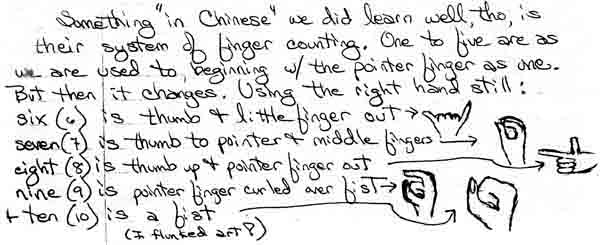
Back to the train trip. When we got an additional eager seat
matte Robt took out another phrase book. This one in Swedish-
Chinese. We had a great time. Others gathered around …. The man
across the aisle with the friendly face who’d been watching us and
speaking Chines to us and laughing …. the 11-year old girl who, every
time I looked up, was watching me, walking by over & over again;
and when I caught her watching me, she quickly giggled & hid her
face. We took out our picture postcards of Seattle & Stockholm,
which were studied w/ great 8hterest and passed through many
hands. People got braver & braver, using the phrase book and these
two young men who knew a little English to ask us questions: where
we lived, our jobs, if we had children, wages, interests & hobbies,
what we thought of China, what the trip cost us (an
incomprehendable sum to them, as our wages & living costs are, too
…. so we tried to always answer this question with “two months
wage”).
Towards evening, I noticed a man walk by us several times,
nervously looking everywhere but at us. Finally, he spoke. His
English was quite good, but he wasn’t used to hearing English spoken;
so we learned to be careful & guard against misunderstanding. We
estimate him to be about our age. He’s a teacher, an intellect,
outspoken & forceful. I’m sure he’s a very demanding teacher, giving
personal attention to his students with promise and feeling great price
in those students who succeed. He himself had been cut off in his
prime, graduating from “high school” right when the Cultural
Revolution was blooming. He was shipped to the countryside for eight
years of “re-education”. After the revolution, out friend was “too old”
for the university education that he should have had. So he routes
his drive & his dreams thru his students.
But active & interested in all he remains. He obviously reads a
lot and knows a lot about the word. He asked about the American
Indian situation, He asked if he French are really stubborn about
their language, He asked why Japan is progressing so much better
then the U.S. And more. We, in fact, made a quick determination to
change our travel plans …. And as the train pulled in to Luoyang,
where our friend lived, we decided to jump off with him … at
midnight! Because we didn’t know yet if Luoyang was an “open city”
where we were allowed & because we didn’t know if we could just
leave our booked route (it was & we could), our friend suggested that
I feign sick. I didn’t like that, but I did it. Soon several train officials
were gathered ‘round and all the passengers were staring. It was
terrible! But I had to pretend.
So there we were in this Chinese city of Luoyang at midnight.
And what does one do? Our friend wasn’t even certain what to do w/
us …. and we certainly didn’t want to create any problems for him,
particularly w/ the authorities. Once we’d found out it was an “open
city”, we relaxed a bit. Our friend checked around for a hotel near
the station but was very worried about them being “dirty”. He finally
arranged something by a phone call and found a moped-rickshaw to
take us the ~6 miles. We bid him adieu and arranged to meet at 9
AM. It was a long way to the hotel .. and was a bit more adventure in
the middle of the night in a strange Chinese city. There were a
surprising lot of cyclists around, a lot of people sleeping on the
sidewalks (country people who’d come to town & couldn’t afford a
hotel // people who find it too hot to sleep indoors), and bats
fluttering overhead. After we’d gone a ways, the moped got a flat.
Our driver left us for about 10 minutes & ran off looking for a phone
but came back w/o results. So we all pushed …. perhaps a half hour or
more before another moped-rickshaw came by. After that driver
delivered his passengers, he returned to us & we switched rickshaws.
But we didn’t get far. The moped soon ran out of gas. Push again, but
this time we didn’t help … It wasn’t so hard for him alone and it
wasn’t but another 10-15 minutes. We got to the hotel at 2 AM! (But
it beat trying to sleep on the train in our “hard seats”!)
Our friend was our guide the next day. Luoyang was, at several
times, the capital of ancient Chine. Some of China’s greatest carved
Buddhas right in the hillside & caves is here. They were great! We
also visited the site of China’s earliest Buddhist temples. And, of
course, we had more interesting discussions.
One more topic he brought up was the execution of criminals.
He was very pro the increased use of execution as a deterrent to
crime. I tried to explain why there is opposition to this in much of the
western world. We didn’t discuss it more and I was later sorry. We
came to witness some disturbing events just a few days later, and
now I see a recent Time magazine article on it (Sept 19) and in a
newspaper here. So perhaps you’ve also read something about the
“crackdown” in China just now.
We were in Xi’an. On Wednesday, Sept 7, some other travelers
told us about something they’d seen in town that day. One of these
women had been living in Taiwan and could speak & read some
Chinese. Then came trucks …. open trucks with people standing …
standing in groups of three … tow police & one prisoner, hands behind
him, forced to lean forward, a sign hanging from his neck with name,
hometown, & crime: murder, rape …. No one got a direct answer to
inquires, but people indicated a gun to the head …. execution, after
the public humiliation.
Then on Friday morning we awoke about 6 AM to the sounds of
a lot of people. Out our window we had an excellent view over a huge
stadium. People were streaming in by the thousands …. for 2-hours
piled in ‘til the stadium was splitting at its seams. We were packing
our bag, eating breakfast, etc., and could hear the loud speaker
system … but unfortunately we couldn‘t understand. People listened
quickly and then cheered. We heard sirens & saw police vehicles &
trucks in he stadium. The hotel attendants weren’t working that
morning. They were all hanging out the windows, abuzz with the
events. But we didn’t understand … some political meting perhaps?
We had to get going. Took our gear & walked to the nearby bus
stop. As we stood there, we were suddenly aware that all the
thousands of pedestrians & cyclists had come to a standstill. The
street attendants were hurriedly motioning everyone to the curb.
Then we heard sirens & saw motorcycle police, then big black cars
with official men smiling & puffing on cigars. “A parade,” I thought.
And then came the trucks …. open trucks with people standing ….
standing in groups of three … But all I saw then were the faces
looking out from over the blue work clothes & the sign that hung from
their necks. Written in Chinese, but I knew it was name, hometown,
crime. Some trucks had 3 prisoners, some had 6 or 7 …. I don’t know
how many trucks went by …. There were many. I was numb. I saw
that many more trucks were coming. I couldn’t look any longer. I
don’t remember that the crowd was frenzied. In my head, I only
remember it deathly silent. The trucks went by & turned towards the
stadium. I read that that was their trial … a public trial conducted
quickly before the cheering crow … followed by execution.
It wash a harsh reminder that we were in another society. And I
do not want to judge another society by the society that I know. But I
can’t stop my feelings & thought. A lesson on China.
Well, this is becoming like a book. I must stop. But I don’t want
to levee China on a downer. We found China with its ¼th of the
world’s population incredibly filled with people … people eager to for
growth … people who glowed “Ah, America” when I said I was from
America … intelligent people, weighted down with the problems of the
past. China must develop … and quickly. China is opening up and
trying new ways. Some private enterprising is now allowed. China
wants to develop. China looks at Japan and sees the miracle there in
30-40 years.
China & the U.S. signed papers 10+ years ago. But what has
happened? Unfortunately, the U.S. hasn’t been able to help so much.
Now Taiwan is the problem. China holds that as the pressure point &
threatens to go to the Russians for “friendship”. The U.S. isn’t playing
her cards right. She’s actually got the ace in her hand.
And now it’s Hong Kong. China will take back sovereignty over
HK in 1997. Two times we met HK-ites while we were in China and we
had dinner w/ them. They say, “Yes, China will definitely take HK
over.” And we all ask each other, “what will happen?” and we all just
sit & s hake our heads.
It’s so unfathomable to sit here & look out at what is HK and try
to think of this as part of the PRC. It just doesn’t fit …. all there rich
high-rises, the neon lights, the fashionable clothing, girlie magazines
sold in the streets, salesmen pulling you in off the sidewalk & high-
pressuring you. It just doesn’t fit. Hong Kong’s just too good of a
thing for China to just throw it all away. No - somehow, they must
find a way of incorporating this HK in & benefiting by it. It’ll be
interesting, to say the least. It’s going to be very important, too.
And exciting. China needs to develop. And the West can help
her do it.
I said this’d be the end. We’re leaving HK on Saturday for
Tokyo. Will stay in Japan one week …. And continue on to Seattle
Sunday, October 2. Leave Tokyo Sunday evening & arrive Seattle
Sunday morning. Weird!
“Happy trails”
love -
Surain
I’ll end by quoting Yuan Mei (1716-1798):
Only be willing to search for poetry and their will be poetry:
My soul, a tiny speck, is my tutor.
Evening sun and fragrant grass are common things,
But, with understanding, they can become glorious verse.
Robert