


|
|
|
l0 September l98l from Islas Galapagos, Ecuador
Aahh! Good morning! I've just awaken and come above-deck to sunshine and calm seas; breakfast is cooking; a few gulls and a pelican are sitting on the railing. We are really, truly in the famous Galapagos Islands. The decision to come out here was made rather quickly, and we're really glad we did. Because the Galapagos is a very protected reserve area, tourism is controlled. We had thought it expensive and necessary to have reservations far in advance. But the busy season ended with August, and we found ourselves being offered tour packages at a big discount because they wanted to fill the spaces. As we sat in one tour office, we began talking with another traveler and together we decided we could do it even cheaper if we flew out on our own and hired a boat. We were able to get tickets for the next morning, and we met quite a lot of other travelers wanting to share a boat, too.
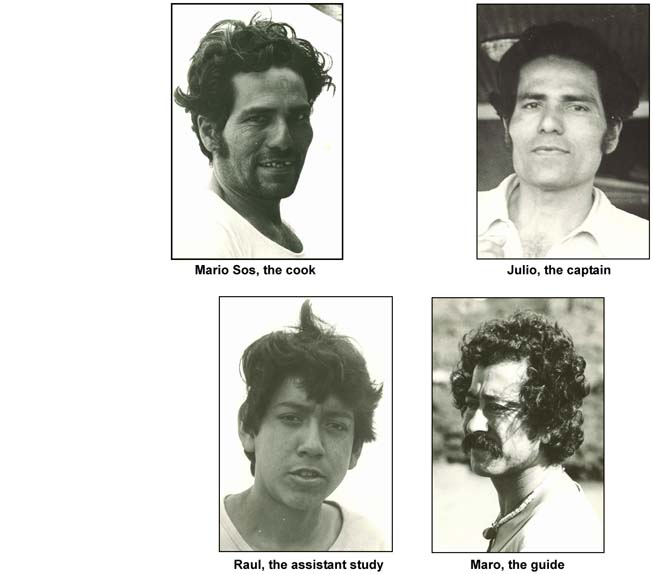
Nine of us are on Lobo de Mar, our boat ... quite comfortably ... plus Julio, the captain; Mario Sos, the cook; Maro, the guide; and Raol, a young student-guide and crew ... a good bunch. We are 4 Ecuadorians, 4 Americans (including me), 2 Israelis, a Swede (named Robert!), a Swiss, and a Scot.
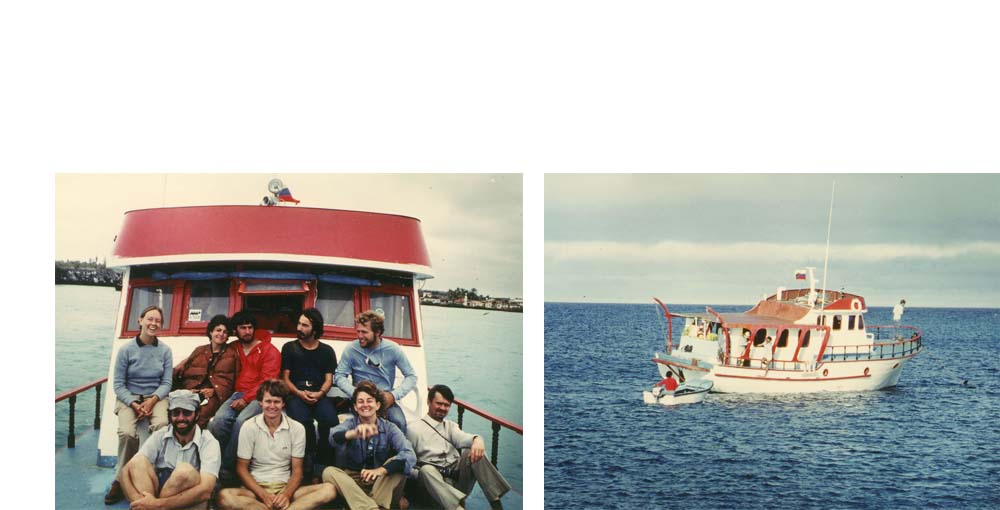
The day we flew out, the whole sky was covered with clouds. But the first day out on excursion, it cleared to blue skies with lots of thin, scattered clouds. On the water at the equator ... a few sunburns, but Robert and I still have good base tans and it's mostly only our noses that continue to burn and peel, burn and peel. Breakfast is ready now. Excuse me for a while. .....
For some Galapagos background, easiest to quote for you ... and very interesting: "The Galapagos have .. never been connected with the continent. Gradually, .. animals and plants .. adapted themselves to Galapagos conditions and came to differ more and more from their continental ancestors. Thus many of them are unique: a quarter of the species of shore fish, half of the plants and almost all the reptiles are found nowhere else. In many cases, different forms have evolved on the different islands. Darwin recognized this .. when he visited .. in l835, and his observations played a substantial part in his formulation of the theory of evolution. Darwin's visit to the Galapagos Islands is one of the landmarks in the history of science. Since no large land mammals reached the islands, reptiles were dominant just as they had been all over the world in the distant past. Another of the extraordinary features of the islands is the tameness of the animals. The islands were uninhabited when they were discovered in l535 and the animals still have little instinctive fear of man."
Consequently, there is no other place else on Earth where you can experience what we are now experiencing. We'd seen a lot of pictures, read a lot, and heard a lot about the Galapagos before coming here. But to stop at that would be like hearing a tantalizing description of an exquisite-tasting pastry and not tasting it. The Galapagos, too, must be tasted. I can only give you words now. I want to somehow convey the wonders. And I want to urge everyone to make this journey him/herself if ever possible. Maybe I go into the business, eh?
Including small islets (of which many play very important, key roles in the life cycles here), there are 6l islands. We visited 8. Each island and each cove seems to have something new to offer. There are a few animals we haven't seen, but I do think we've seen a great sample. Sea lions greet the boat at most stops. They're all over the rocky cliffs and the beaches. The colony at one beach had lots of young ... one that had been born that very morning. Real cute with his big round "cow" eyes. We can walk quite close ... always to keep a distance of at least 3 meters however. With all these young around, the sea lion bull at this particular beach was quite protective. He charged a few of us ... from the water and from land. It's amazing how fast they can drag those huge bodies with those relatively small flippers. They must be incredibly strong. We soon learned to take him seriously and run fast when we saw him coming. He conveyed a serious attitude and continued his chase until we were far up the beach.

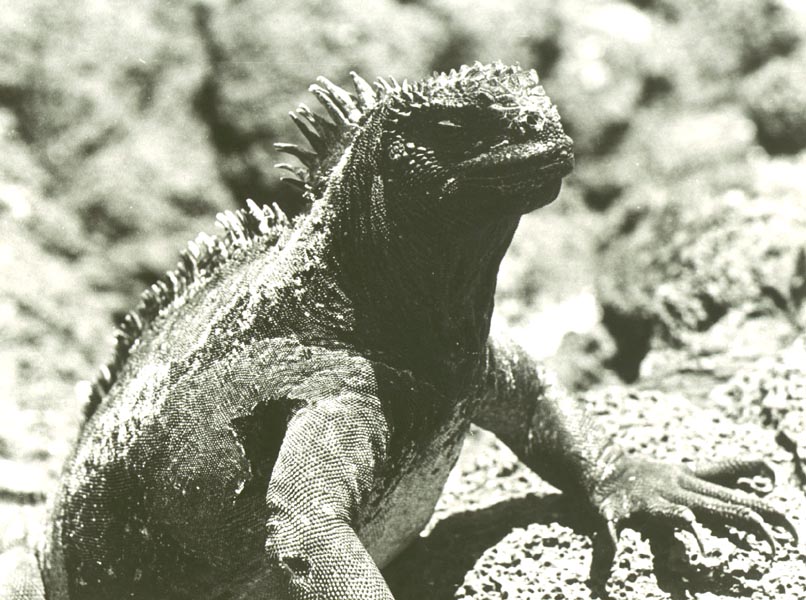
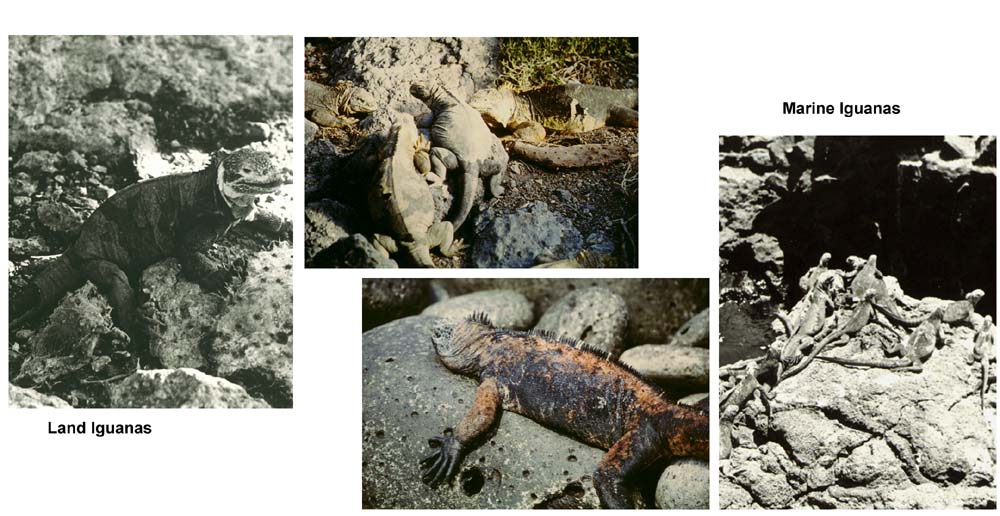
Iguanas. There are two main kinds of iguana: marine and land. The marine iguana are on most all islands, particularly on the rocky shores. They're not a pretty thing ... black, prehistoric looking. They always appear poised, ready to pounce; but in actuality they seldom move. In their dark, rough hides, they're camouflaged against the black lava -- and we have to be careful not to step on them. Sometimes we'd get an upward look at them, silhouetted against the sky. They appear to be standing guard, the head moving from side to side in sporadic, very small, quick movements as if in strobe. The land iguanas look similar except without the horny ridge down the center of their backs, more colorful, and definitely fatter -- different diets. These land iguana eat cactus, a unique variety of the opuntia cactus that has evolved for Galapagos life. This opuntia is larger than its mainland relations -- maybe 20 to 30 feet tall -- and the trunk has evolved to have a thick skin, like a heavy bark. That affords the cactus survival, while the fleshy appendages mean food and survival for the local inhabitants.
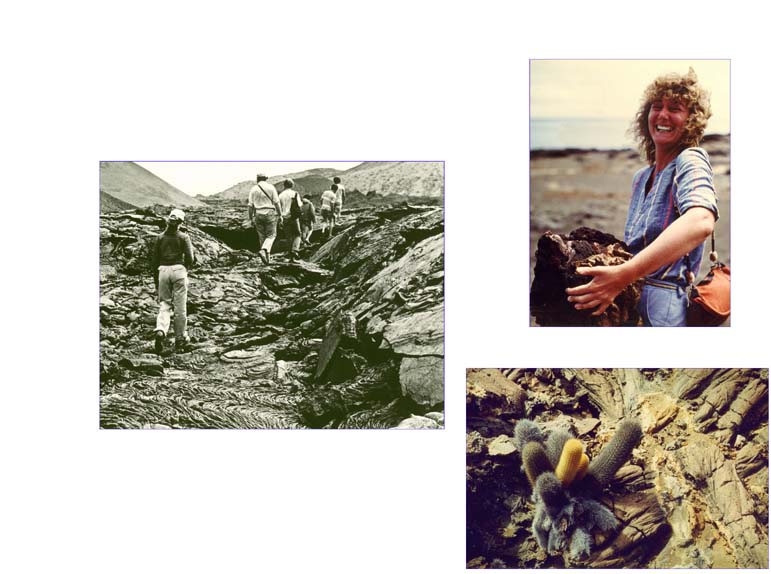
The Galapagos Islands are volcanic. Some areas are barren where, even after l00 years, plant life hasn't yet taken hold. Sometimes a lone, small cactus will be the beginning of soils and vegetation to come over the centuries to come. Several kinds of lava have been pointed out. Names I can't remember. One was "a-a" or some such spelling. It's quite fragile. With different qualities, lavas take on different kinds of formations. Quite magnificent. Some porous and lightweight -- others very heavy. Different colors, from black to red. Some lava fields show bubbles where gases escaped.
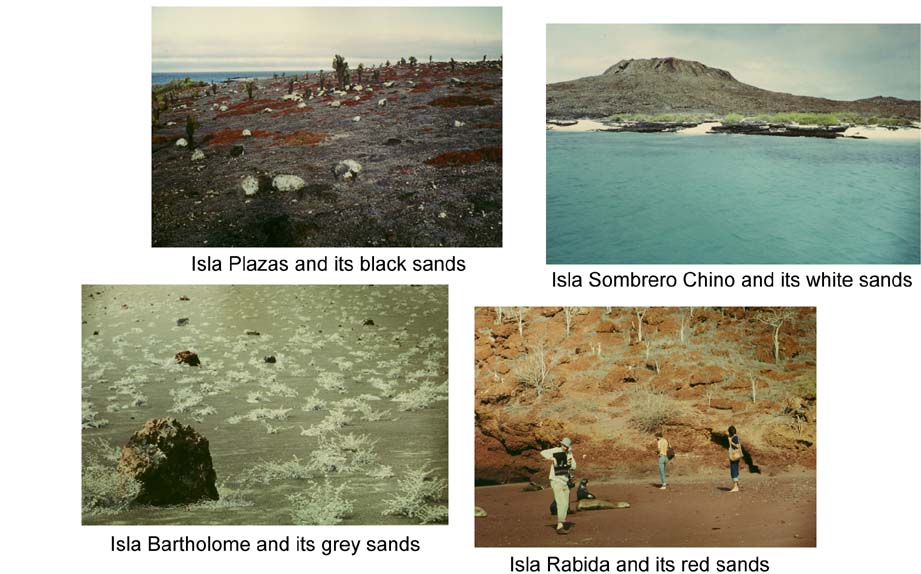
Beaches are beautiful. Some with very white sand -- others golden beige -- some a strong red -- and others dark, almost black. When going between beaches, between islands, one must clean shoes, feet, pants, etc completely of all sand or seeds. All precautions are taken to keep islands stable. The inadvertent introduction of a new seed to an island can begin a change effecting the normal cycle of all the islands.
In past years, goats, pigs, cattle, dogs, cats, rats, etc had been brought here by man. There were no land mammals before man came. Those animals have wrought great destruction to the plant and animal life of the Galapagos. Now with many of those "immigrant" animals living wild, attempts are being made to wipe out and/or control those populations.
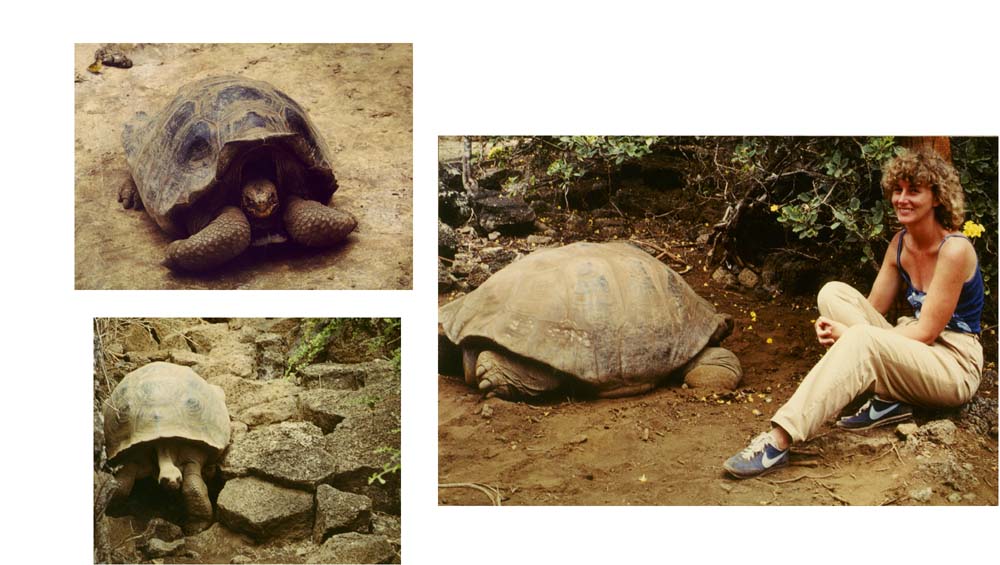
But it's too late for some. Several species have been wiped out, and several more are near extinction. Especially suffered are the famous Galapagos tortoises -- those huge, lumbering land tortoises. Reserves are now set up to protect the young, or they'll never live long enough to survive on their own.
We've also seen a good showing of sea turtles, which is said to be unusual for this time of year. Nine of us crowded into a little dinghy and floated quietly hoping for a glimpse of them. Just a little patience and we were rewarded with many appearances ... noses popping up to take a look at us. At another place where we were anchored over white sands, we could watch their silhouettes swimming underneath. Talk about silhouettes swimming underneath our boat ... We also saw manta ray and a hammerhead shark "au silhouette". The last was when Robert was taking a refreshing dip. Our guide advised us that it was nothing to worry us, but Robert decided he'd had enough swimming that day anyway.
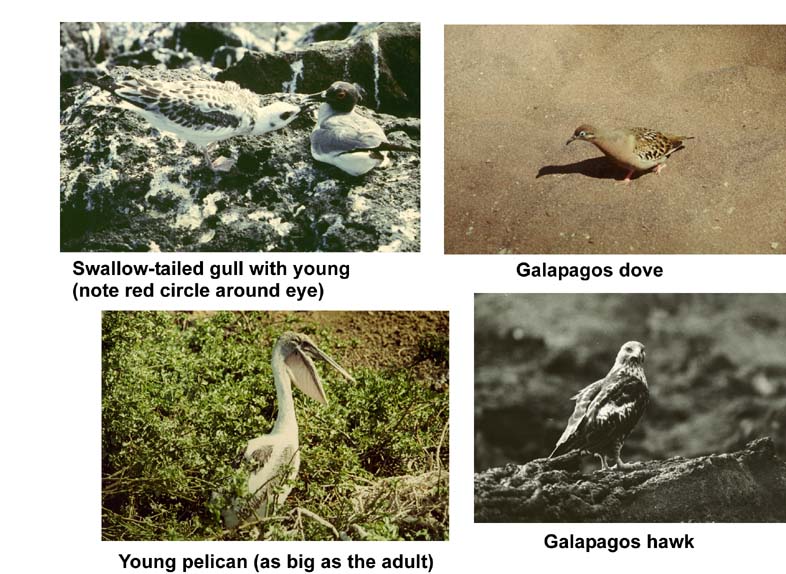
Sea lions often play around the boat ... really fun to watch, so playful and pretty. We saw porpoises only once and at a distance. Pelicans followed the boat everywhere, and they'd prop themselves on the railing or on the dinghy whenever we anchored, hoping for handouts. Big birds, they look as if they want to be adopted. We saw some pelicans nesting and several young covered still with down, yet HUGE. I think it was the birds of the Galapagos which fascinated me most of all: penguins, flamingos, many finches (Darwin's finches, you know!), lovely swallow-tailed gulls, lava gulls, oystercatchers, at least three kinds of herons, tropic birds, boobies, frigates, etc. I must elaborate on the boobies and the frigates: unique appearing and most fun to see because we got to see whole colonies, with courting, nests, and babies.
There are three kinds of boobies in the Galapagos Islands: blue-footed red-footed, and masked boobies. Because, as with many of the animals here, the different breeds concentrate in different areas, we got a good look at only the blue-footed boobies ... and, yes, their feet are really blue ... a brilliant, almost-turquoise blue color.
One of the peculiar characters of the boobies are their eyes. Whereas most birds' eyes are set to look toward the sides, the booby's eyes look forward, straight at you down a long, pointed beak. It's so contrary to what we're used to seeing, that the first impression is that they're cross-eyed. The booby is a diver however. And this eye placement helps them in their straight-on chase of their prey underwater. They're diving was fascinating. I could watch that for hours. The birds start their dive quite high and get up great speed as they head down. Then from perhaps 10-15 meters up, they tuck their wings and drop into the water like a rocket! Even from a distance, one can hear the "swish - plop". They often fly in numbers and dive together. What a sight! 20 to 30 of them ... swish, swish, swish, plop, plop, plop ... and then silence as they stay under an incredibly long time ... then pop, pop, pop, as they pop to the surface and bob there like corks. What a sight! I loved it!
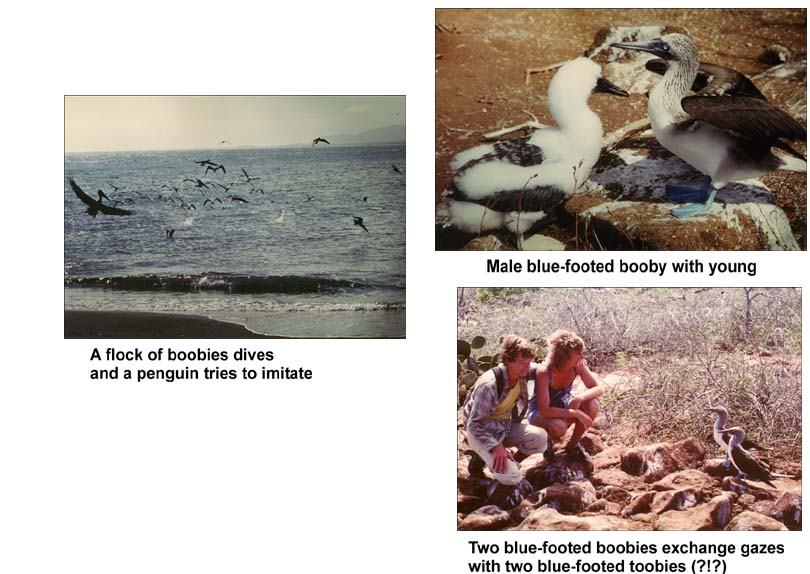
Yesterday we were on Isla Seymour Norte, where a lot of the blue-footed boobies nest. They don't have "nests" actually. They just make a shallow indentation in the ground. We did have to be careful where we walked. They didn't shy away from us, not even the fluffy, young ones.
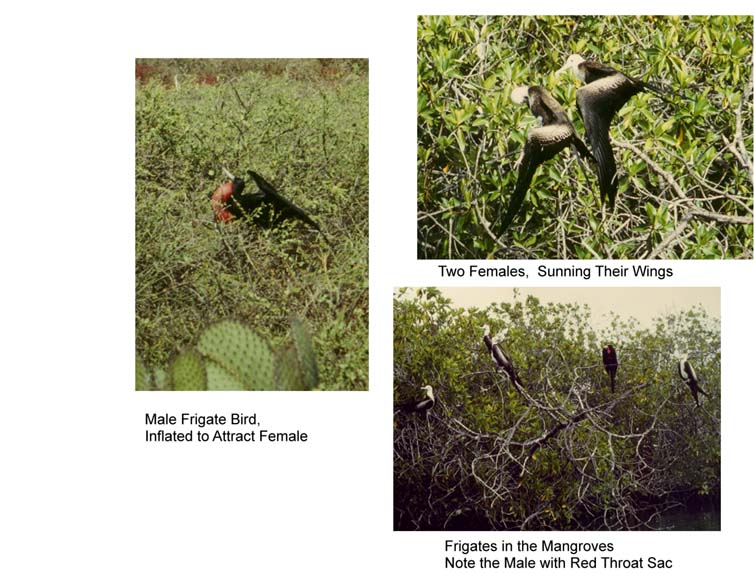
Frigates: If you've ever seen any pictures from the Galapagos Islands, good chance you've seen this bird. The male has a red pouch below his beak that inflates when he wants to attract a mate. The pouch inflates quite large in relation to body size. His beak is long and points down at the end. It looks as if the beak will pop the pouch! The frigate's wing-span is up to 8 feet wide, and is said to be the largest in relation to body size of all the world's birds. One time we saw a number of these birds "sunbathing" ... sitting in some branches with winds spread out and upwards. Quite a sight. We've seen lots of them in flight also. The winds have an odd angle and the tail is "forked". I'd begun to worry that we might not see any of the famed courting, and that would have been a big disappointment. But we saw two colonies of them yesterday finally. The courting is quite beautiful. The male sits all puffed and proud -- He stays inflated for 2-3 hours -- so big the head must tilt back. When a female flies near, he spreads his wings and flaps them ... and he claps his beak real fast, sounds kind of like a woodpecker. Quite a show!
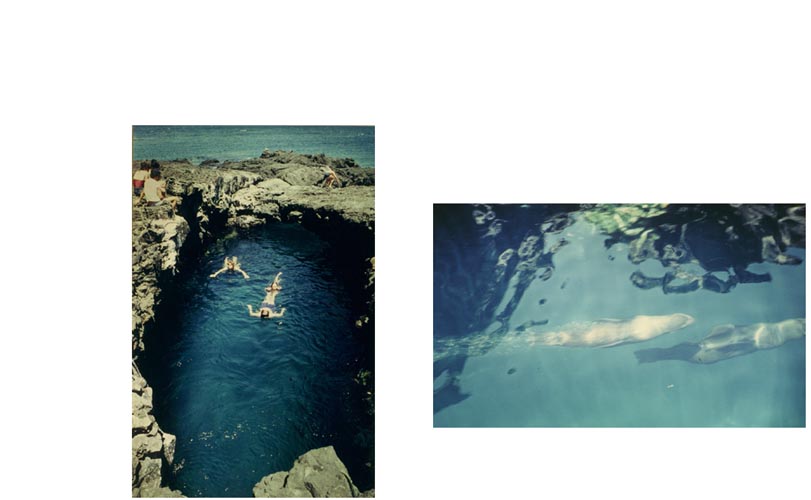
I've been saving my favorite story 'til last. One day we took our swimsuits ashore with us and walked along lava beds that had formed inlets from the sea. We came to one about l0 feet wide and maybe 50 feet long with a natural bridge at the end toward the sea. The bridge came down to the water, but we could dive under and swim out to open sea here. Fantastically beautiful with white sands under and blue, blue waters. Hundreds of marine iguanas stood all around like little sentinels. A Yellow-Crowned Night Heron stood watch on a ledge. And half a dozen fur seals climbed on the ledges and dove and swam in and out. They played together -- twisting and turning, standing on their heads with tailfins in the air, diving, jumping. And we swam with them!!! They are so playful and like to tease us. We could swim alongside them, they'd roll and we'd roll. But if we got closer than about 5 feet, they'd dive down and come up on the other side of us. Wow! What a place! Dorothy Lamour eat your heart out! Sound too ideal to believe? Just wait! We have pictures, and even film.
Oh, boy, do we have pictures. Between the two of us, we took over 250 slides here. Robert took four black and white films and four movie films also. You shall see the Galapagos!
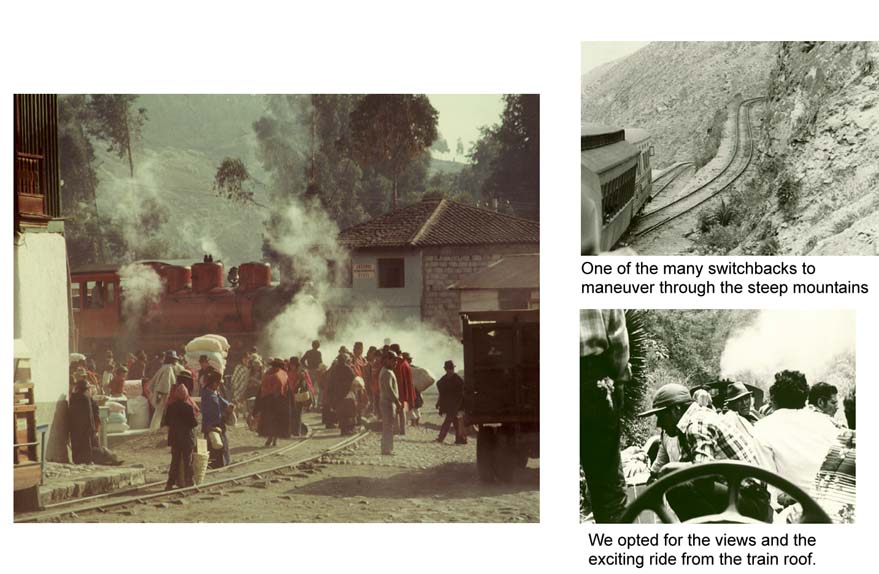
Well, after the Galapagos, it seems a bit anti-climactic to consider telling you about our expedition into the wild jungles in Ecuador's Oriente, with it's roaring, rain-swollen rivers that rose over 5 meters in just a few short hours ... or about the beautiful snow-capped mountains at the equator, including the magnificent Chimborazo, the world's "highest" peak (when measured from the center of the Earth) ... or about our train trip sitting on top of the freight cars as we descended the Andes so steeply that the train had to reverse down switchbacks. Ecuador has lots to do and see. We've really enjoyed this country. It needs a lot of time. We've barely scratched the surface.
We're healthy, have renewed our tans, have washed our clothes ... ready for new adventures. Hope all is as well at home, but perhaps not as adventurous. After all, we wouldn't want to miss out on anything!
our love and hugs -- kramar!
|
|
|
[Letter 7] |